
Saturday, May 22, 2021
Friday, May 21, 2021
PHOENIX – The words were light, yet poignant.
“If we would’ve had an injury problem or a COVID outbreak, you might’ve seen my big tummy out there in left field.”
That’s what former Seattle Mariners President Kevin Mather said during a video call with a local rotary club on Feb. 5, adding that there was no way any of the team’s top prospects could have made the Major League roster last September out of reluctance to start their service time clocks.
These words from Mather, along with a handful of other statements regarding the Mariners in the same meeting, ultimately led to his resignation on February 22 after the video from the Bellevue Breakfast Rotary Club surfaced. They also mark Major League Baseball’s latest instance of service time manipulation, a practice that aims to prolong the amount of time that teams retain club control of top prospects while paying them the minimum allowed by the league.
While the situation involving the Mariners’ prospects may have been out in the open, most instances of service time manipulation are relatively quiet. Teams generally don’t admit to manipulating a player’s service time and often attempt to justify keeping them down by claiming more development is needed.
Due to the nature of service time manipulation, one can only guess how widespread the practice is.
“It is your job as a (general manager) to most efficiently use the system to your benefit, and so I think every team does it,” said Zach Buchanan, the Arizona Diamondbacks reporter for The Athletic.
MLB’s service time rules
Service time manipulation in baseball exists largely due to MLB rules that — either deliberately or unintentionally — incentivize keeping players who are “ready” for major league competition in the minor leagues to maximize the amount of time they are under their club’s control.

PHOENIX – Although Arizona is the site of two NCAA softball regionals this week, that might not be the case next year if the state passes a law requiring athletes to compete in interscholastic sports based on their sex at birth.
The “Save Women’s Sports Act” was introduced on Feb. 3 as House Bill 2706, and passed in a party-line vote of 31-29. The ban on transgender students participating in girl's sports was sponsored by Rep. Nancy Barto, R-Phoenix, and will be introduced to the state Senate in early May.
The NCAA Board of Governors, which is comprised of university presidents and chancellors, issued a statement on April 12 that it “firmly and unequivocally supports the opportunity for transgender student-athletes to compete in college sports” and that “when determining where championships are held, NCAA policy directs that only locations where hosts can commit to providing an environment that is safe, healthy and free of discrimination should be selected.”
Advocates for the transgender community were surprised Sunday when three states – Arkansas, Alabama and Tennessee – which already have legislation banning transgender athletes from interscholastic competition, were named by the NCAA as hosts for the postseason softball tournament which begins Thursday. Arizona State and the University of Arizona are also hosting games.
Backlash from the decision could prompt the organization to be more selective in naming sites next year.
Arizona is among dozens of states that are considering passing legislation related to the federal “Protection of Women and Girls in Sports Act,” which specifies that sex shall be recognized based solely on a person’s reproductive biology and genetics at birth. A lawsuit filed last February is at the root of the proposed legislation.
Thursday, May 20, 2021
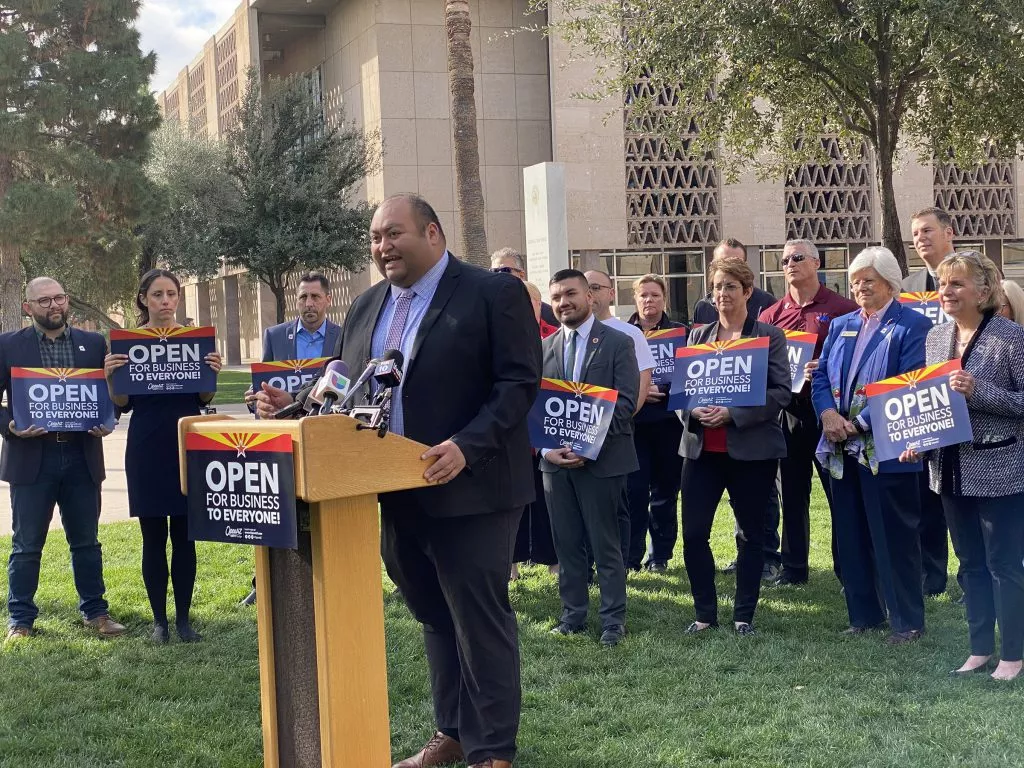
State Rep. Daniel Hernandez (D-announced today that he was launching a campaign for the
congressional seat now held by U.S. Rep. Ann Kirkpatrick, who announced earlier
this year that she would retire after this term.
“As a lifelong Arizonan from a working
class family, I know firsthand that people in Southern Arizona want results
from their representatives, and as our community recovers from this pandemic,
that’s never been more important,” said Hernandez in a prepared statement
announcing his campaign. “In the
Arizona State House I have fought for investments in our schools, our
hospitals, and our roads and bridges. I have worked across the aisle to pass
laws protecting survivors of sexual assault and repealing discriminatory laws
against the LGBTQ Arizonans. I’m running for Congress to keep up that fight for
our values and deliver real results to make our community stronger.”
Two
other state lawmakers, State Sen. Kirsten Engel and State Sen. Randy Friese, have
already launched campaigns in the district.
Hernandez
is best known for being the first person to administer first aid to Gabby
Giffords after she was shot through the head by a crazed gunman at a Congress
on Your Corner event in January 2011. Hernandez was then an intern for
Giffords, but in 2016, he won a seat in the Arizona House of Representatives in
Legislative District 2, which includes downtown Tucson, Green Valley, Sahuarita
and Nogales.
Congressional
District 2 now includes the Catalina Foothills, central and eastern Tucson and all
of Cochise County and has been one of Arizona’s most competitive districts,
being held by Democrat Ron Barber for one term, Republican Martha McSally for
two terms and now Kirkpatrick for two terms. But with redistricting underway,
the boundaries will change ahead of the 2022 election.
The spelling of state Sen. Kirsten Engel's name has been corrected in this article.

Pima County is expanding vaccine opportunities, offering daily walk-in vaccinations at Foothills Mall.
On Sunday, the vaccination site, located in the former Old Navy store, began offering vaccinations for all ages from noon to 8 p.m. every day.
“The large operations made an incredible impact and allowed us to vaccinate hundreds of thousands of people in a matter of just months,” said Dr. Theresa Cullen, director of the Pima County Health Department. “Over the course of the last few months, we have also been tremendously successful in building up and perfecting our mobile and smaller-scale operations as well. It is easier than ever to get a COVID-19 vaccine in Pima County.”
Since the state began vaccinating children ages 12 to 15 after a green light from the FDA on May 13, the county has expanded its locations offering Pfizer.
The county continues to offer vaccinations at several mobile sites every week, along with the FEMA pop-up sites.
Thursday, May 20
- Richey Resource Center, 2209 N. 15th Ave., 9 a.m. - 3 p.m.
- Cornerstone Fellowship Church, 2902 N. Geronimo Ave., 1:30 - 3 p.m.
- New Jerusalem Missionary Baptist Church, 1341 S. Tyndall Ave., 3 - 7 p.m.
- Antigone Books, 411 N. 4th Ave., 6 - 9 p.m.
Thursday, May 20 - Friday, May 21
- Northwest Service Center, 1010 W. Miracle Mile, 10 a.m. – 8 p.m.
- Pima Community College East, 8181 E. Irvington Road, 10 a.m. – 8 p.m.
Friday, May 21
- Amphi High School, 125 W. Yavapai Road, 10:30 a.m. - 2 p.m.
- Grace Temple, 1020 E. 31st St., 4 - 7 p.m.
- Pueblo High School, 3500 S. 12th Ave., 5 - 9 p.m.
Saturday, May 22
- Friendship Missionary Baptist Church, 850 N. 11th Ave., 8 a.m. - 1 p.m.
- St. Joseph Catholic Parish, 215 S. Craycroft Road, 9 a.m. - 1 p.m.
- St. Pius X Catholic Church, 1800 N. Camino Pio Decimo, noon - 3 p.m.
Sunday, May 23
- Saguaro Christian Church, 8302 E. Broadway Ave., 2 - 6 p.m.
- Saints Peter & Paul Catholic Church, 1946 E. Lee St., 8 a.m. - 2 p.m.
- Most Holy Trinity, 1300 N. Greasewood Road, 11 a.m. - 2 p.m.
Sunday, May 23 - Tuesday, May 25
- COPE Community Services, 5401 E. 5th Street, 10 a.m. – 8 p.m.
- Park Place Mall, 5870 E. Broadway Blvd., East Parking lot (east of Park Place Drive), 10 a.m. – 8 p.m.
Ongoing
- Tucson Mall, 4500 N. Oracle Road, 11 a.m. - 3 p.m., Monday through Friday
“The number of places to get vaccinated and how easy the process has become is making it more accessible to those looking to join the over 3.1 million people in Arizona who have received at least one dose,” said Cullen. “Our goal is to be ready and nearby when someone makes the decision to get theirs.”
With its shift to smaller sites, some of the larger operations within the county will close, including the CareMore Health location at 4750 S. Landing Way, near Irvington and I-19, on May 21; and the Tucson Convention Center site will close May 28.
As of Wednesday, May 19, the state has administered more than 5.5 million vaccines, with about 37% of the Arizonans fully vaccinated. The state has remained at a substantial level of transmission for several weeks with a rate of about 65 cases per 100,000 for the week of May 2. Pima County remains below 50 cases per 100,000 for a moderate rate of transmission for the past three weeks.
Tucson Repeals Mask Mandate
After the Pima County Board of Supervisors voted to drop its mask mandate last week, the Tucson City Council followed suit and unanimously voted to repeal its mask mandate Tuesday night.
AJO – It was a simple message scrawled into a basalt rock lying near-empty cans of beans and jugs of water that volunteers had left deep in the Sonoran Desert for undocumented immigrants passing through: “Gracias.”
But to Mikal Jakubal, who, as a volunteer with the Ajo Samaritans, had been making weekly trips into the backcountry to stock water drop locations, the note was affirmation that the group’s efforts were appreciated.
“For the most part, we will never hear from the people who use this,” Jakubal said. “We don’t know what it was like getting to this point. We don’t know what is after this. But you have this one little connection across massively different life experiences: They found some water and you found a thank you note.”
Mark Diekmann, a volunteer with People Helping People in the Border Zone in Arivaca, located 11 miles north of the U.S.-Mexico border, said those moments make his work worthwhile.
“Every time you give somebody water, they appreciate it. Every time you give somebody warm clothes,” Diekmann said. “Every time you give them a warm place to be and they know, for the moment, that they’re going to be OK.”
Two decades ago, when the U.S. Border Patrol began to focus on more populated areas in California and Texas and general enforcement increased across the southern border, migrants began venturing into more remote areas to cross the U.S.-Mexico border undetected. Since then, local humanitarian aid groups in southern Arizona, such as the Ajo Samaritans and People Helping People in Arivaca, have been working with a core mission: to mitigate suffering and death in the harsh desert wilderness of Arizona borderlands.
Even so, the bodies of 227 undocumented border crossers were found in the Arizona desert in 2020, a record. Dr. Gregory Hess, chief medical examiner with the Pima County Office of the Medical Examiner, attributes the increase to last year’s hot, dry summer.
“When I started here in the late 2000s, I don’t think anybody would have dreamed that we’d still be seeing these types of numbers now,” Hess said.
And absent meaningful efforts to address the factors that drive people to risk their lives crossing miles of unforgiving desert, the problem will continue, Hess and other experts say. It is an issue driven by global factors. Although most of the migrants come from Latin American countries, people from Asia, Africa and the Middle East are represented among those crossing the border.