Monday, May 17, 2021

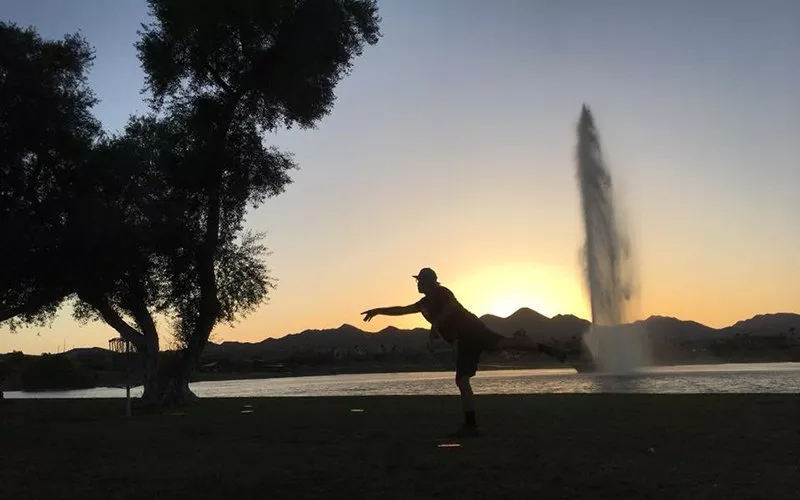
PHOENIX – Carla Walker was tired of sitting inside during the coronavirus pandemic. She missed going to the gym, shopping and spending time with friends and family. Her retail job in Central Phoenix had laid her off and she had time on her hands. She wasn’t sure how to fill it.
One day while returning from buying groceries, she took a different route to avoid traffic and drove past something she had never seen before: a disc golf course.
“I remember seeing two guys throwing a Frisbee, but not to each other or to a dog,” Walker said.
She dropped off her groceries at her apartment and returned to Conocido Park in North Phoenix to walk around and watch a little longer.
“They were throwing the Frisbees at these metal basket things on poles,” Walker said. “It looked sort of weird but I could see a bunch of other baskets around the park and figured that’s how you play the game.”
Walker did research on her phone and learned they were playing disc golf. She watched a few videos and quickly learned the rules. She even found a beginner’s set of discs online and bought them while she was still at the park.
When the coronavirus pandemic put a halt to most recreational sporting events and activities, people began looking elsewhere for exercise and competition. While many indoor sports are slowly returning, outdoor activities have seen major growth and involvement in the last year. Disc golf is one of them.
The sport is similar to traditional golf. Participants begin at a tee box or launchpad and throw their disc toward a “hole,” which is an elevated, metal basket. Each hole has a set number for par, and scoring is the same as traditional golf, where each throw equals one stroke. A round of disc golf is typically 18 holes but some courses also offer nine and 27 or more holes. Depending on how busy the course is and how quickly one plays, a round of disc golf can take anywhere from one to three hours.
Phoenix police don’t follow Fe’La iniko on social media, but he knows they’re watching.
“They’re pretty hip to Instagram,” the racial justice activist said. “Sometimes they’ll pop up in my story views.”
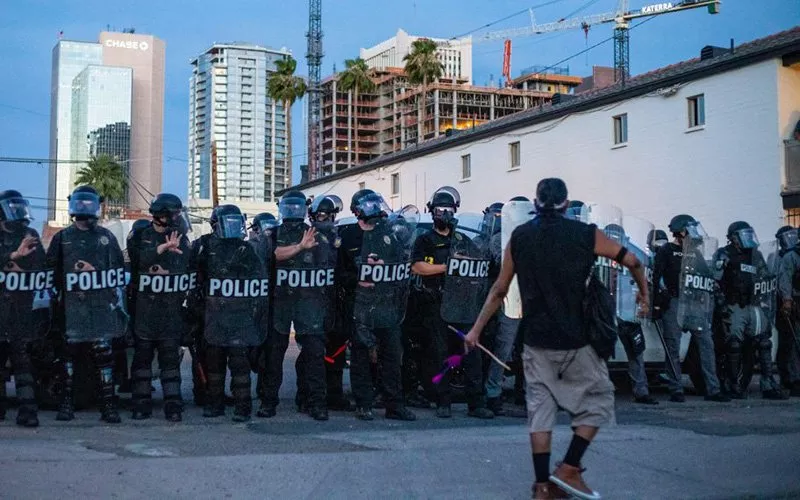
Iniko, whose given name is Milton Hasley, often uses social media to share fliers on upcoming protests or speak out against police violence. So when officers surrounded his car last summer while he was leaving a demonstration against the killings of George Floyd and Dion Johnson, iniko worried he might have been targeted in advance for his views. As a handful of cop cars trained their spotlights on him, he was careful to keep his hands visible as he placed them on the steering wheel, a video he posted on Instagram shows.
“Try not to look threatening,” he remembered thinking.
Hours later, iniko was booked into jail and charged with two felonies and two misdemeanors, all of which were later dropped. He was one of hundreds of Phoenix protesters arrested during last year’s demonstrations against systemic racism and police brutality, which were met with an aggressive police presence and a number of controversial charges from prosecutors.
Police reports and court records would later reveal that police surveilled some of the protesters on their social media accounts during the summer and fall.
It was a year that would see Black Lives Matter demonstrations and civil unrest followed by anti-lockdown rallies, election protests and the fatal Jan. 6 storming of the U.S. Capitol. In the Capitol insurrection, law enforcement officials scoured social media platforms, sweeping up photos, videos and comments that have helped to identify, arrest and charge hundreds of people.
This form of online policing has gained traction as a means of addressing the looming threat of domestic terrorism. But many agencies — including the Phoenix Police Department — work under barebones guidelines when monitoring online activity.
Sunday, May 16, 2021
Saturday, May 15, 2021

Friday, May 14, 2021
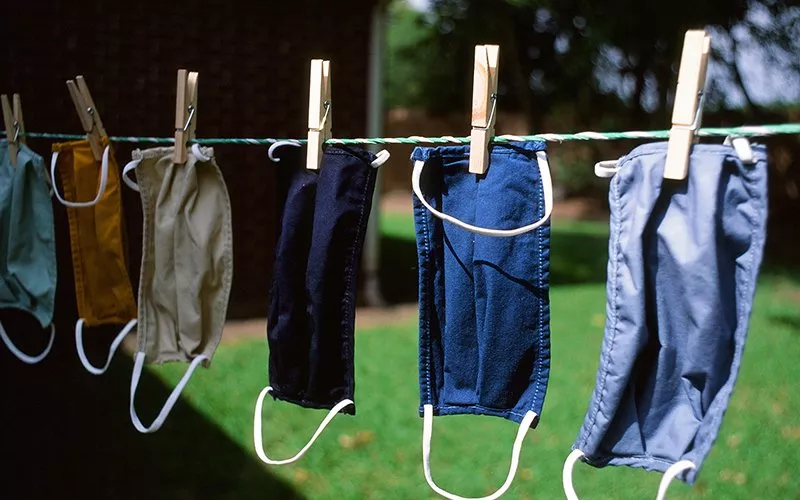
The Pima County Board of Supervisors voted to 4-1 to repeal the mask mandate and continue recommending masks at the emergency meeting Friday afternoon.
In order to stay in line with the Center for Disease Control and Prevention’s updated guidance on Thursday, announcing fully-vaccinated individuals can go unmasked in indoor and outdoor settings in most cases, the board passed Resolution_2021-35. The resolution repeals Resolution 2020-96, the mask requirement, while continuing to recommend mask use for unvaccinated individuals and in some cases those vaccinated.
The county’s Chief Medical Officer Dr. Francisco Garcia acknowledged the contradictions between the board’s resolution and the CDC’s recommendation, as the resolution required face masks without differentiating between fully vaccinated and unvaccinated individuals.
County Administrator Chuck Huckelberry suggested three directions the board could take.
The first suggested the board could amend its current resolution to apply only to unvaccinated individuals and exempt fully vaccinated persons.
“This action, although symbolically meaningful, would be unenforceable,” wrote Huckelberry in his May 14 COVID-19 update.
The second option, which Huckelberry, along with Pima County Health Department Director Dr. Theresa Cullen and Garcia recommended the board select, opted for considering a new resolution to repeal the previous mask mandate and provide new recommendations.
The last option suggested the Board could simply repeal the resolution, which Supervisor Steve Christy made an unsuccessful motion to pass.
Ultimately the board chose the second option, aligning with the CDC in recommending continued use of masks and other mitigation strategies like social distancing for the unvaccinated people, while also recommending masks for all, vaccinated or not, on public transportation and in 'health care settings, schools, correctional facilities, shelters, congregate facilities and any other setting where it is required by local, state or federal law.” These recommendations are also in line with CDC’s updated guidance.
The resolution also requests establishments provide masks for employees who are not fully vaccinated and encourage the use of masks, but makes clear the resolution does not prevent establishments from setting their own standards on masks and social distancing, or refusing service for noncompliance.
After the resolution, Christy motioned to “rescind, remove and terminate” board Resolution 2020-18, which declared Pima County in a state of emergency related to the COVID 19 outbreak. The motion died for lack of a second.

A new poll shows bipartisan support for President Joe Biden’s infrastructure and care plan in key states, according to Data for Progress.
From the end of April to early May, Data for Progress, a think tank and political advocacy group, surveyed an average of 642 likely voters in each of 10 key states - Arizona, Colorado, Georgia, Michigan, Montana, New Hampshire, North Carolina, Pennsylvania, West Virginia and Wisconsin.
The survey measured the support for Biden’s Build Back Better agenda, including the American Rescue Plan, American Jobs Plan and American Families Plan.
The majority of likely voters in all 10 states supported the American Rescue Plan. In Arizona, 72% supported the plan, with most giving credit to the Democratic Party for passing provisions including vaccine distribution, stimulus checks and expanded child tax credit.
The poll also showed net positive support for The American Jobs Plan and American Families Plan in all 10 states, even when voters were told the plans would be paid for raising taxes on corporations and the wealthy.
“The idea that paying for these plans is unpopular is patently incorrect. In fact, those provisions actually make people more supportive of the idea,” said Sean McElwee, executive director for Data for Progress.
In Arizona, 68% of support the American Jobs Plan and a little more than half of those who self-identified as Republicans support the plan. About 80% of likely voters in Arizona supported the proposed investments in physical infrastructure, lead pipe removal and long-term care.