

Saturday, May 8, 2021
Friday, May 7, 2021
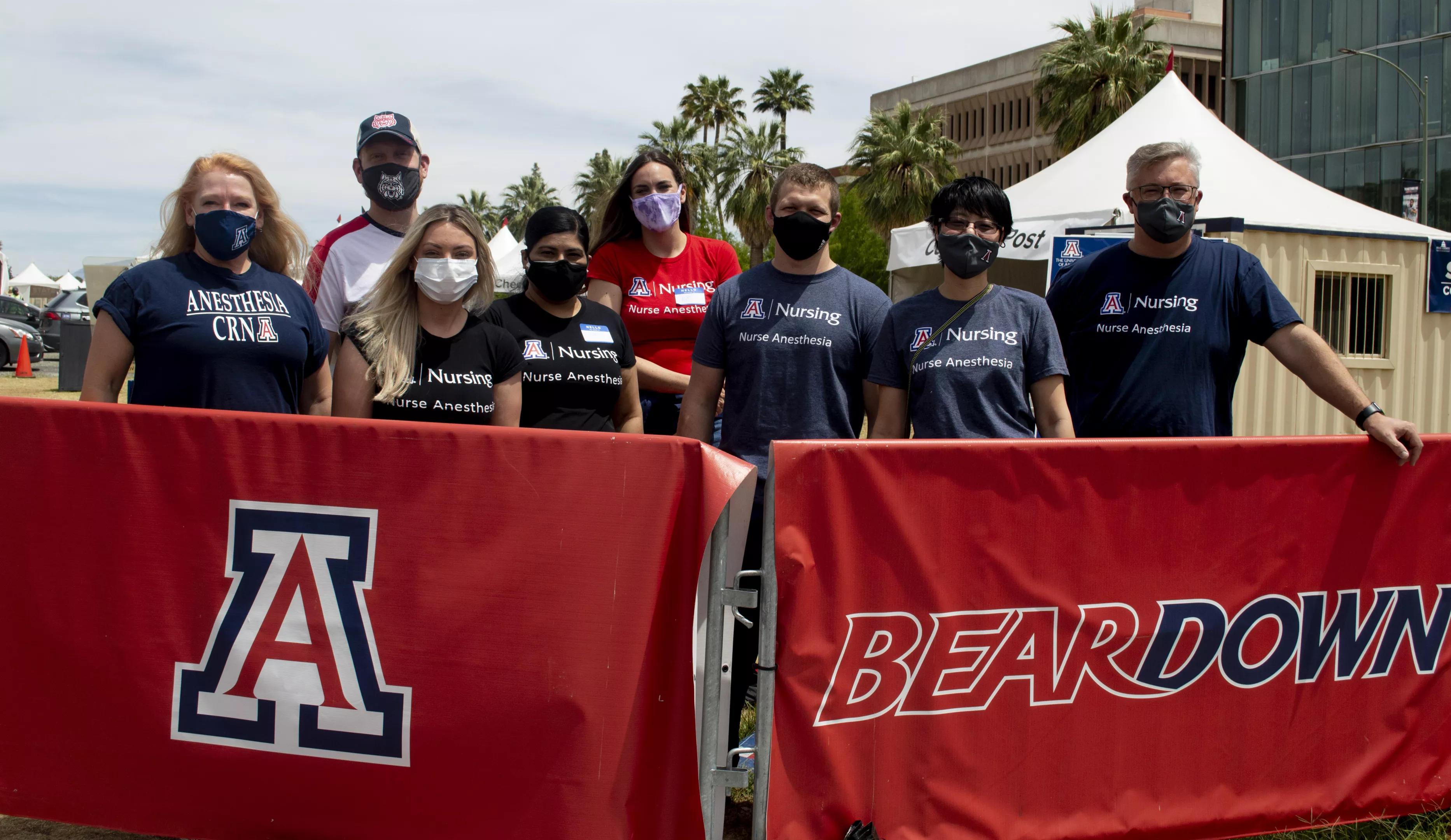
University of Arizona College of Nursing faculty and students with first-hand experience of the human cost of COVID-19 ran a vaccination clinic last weekend.
Led by Kristie Hoch, UA clinical assistant professor and program administrator of the Nurse Anesthesia Specialty, volunteer Certified Registered Nurse Anesthetists (CRNAs) and student registered nurse anesthetists (SRNAs) administered vaccines to people at the drive-thru.
For about 150 years, CRNAs have been preparing patients for anesthesia before surgical procedures, said Hoch.
“We ensure patients are safe and comfortable during their anesthesia and this piece for us is part of ensuring our community is safe,” said Hoch, referring to vaccinations as part of that work.
Since the onset of the pandemic, CRNAs have found themselves outside of the operating room.
“Really the entire scope, not just for surgery pre-intra and postoperative care, but we’ve been called to take care of patients who are acutely and chronically ill with COVID,” said Charles Elam, clinical assistant professor at the College of Nursing. He said he and his partner were hired to manage acutely ill COVID patients in Green Valley. They installed central lines, big IVs that go into the neck or chest, and arterial lines that go into arteries. They also managed ventilators and sedated patients.
“This was above and beyond what we typically do, but because we are airway experts we were called upon and stepped up to do what we needed to do,” said Hoch.
Phillip Bullington, 31, one of the five doctoral students in the Nurse Anesthesia program who volunteered at the vaccination event, worked as a nurse before beginning his doctoral project and has experience dealing with people who are severely ill.
However, what he experienced as an SRNA in the ICU during the pandemic was beyond his expectations.
“We never really expected the way everything happened and then it just got crazy,” recalled Bullington. "Where there's people on ventilators just taking up all the ICUs. We're turning other floors into ICUs and we're running out of places for patients to go. And then they would get sick, but they were healthy enough that they would still live for a while, but they weren't getting better. So just a piling of people who would get more sick and there was nowhere for them to go.”
Pima County officials are hoping they get lucky enough to overcome vaccine hesitancy by setting up mobile vaccination sites at the Desert Diamond and Casino del Sol this weekend.

Pima County and the Federal Emergency Management Agency are teaming up to launch mobile vaccination units this weekend to reach vulnerable communities with high risks of COVID-19 exposure and infection.
The operation includes two mobile vaccination units, able to administer 250 vaccines per day each, along with administrative staff and federal vaccinators with 70 personnel from FEMA, Health and Human Services, the Environmental Protection Agency and Department of Labor, according to a county press release.
The units will run through June 26, operating at two concurrent locations for three days, with one day to tear down and move to the next location. The locations were selected based on census tract data and the Social Vulnerability Index of the area to identify highly vulnerable communities.
The sites will offer walk-up vaccinations of both the Moderna and Johnson & Johnson vaccine for those 18 and older on a first-come, first-served basis. Vaccinators will return to the same mobile site 28 days after their first visit to receive their second dose, following CDC guidance. Help will be available to all who need assistance with mobility, language or other accommodations.
Here are the planned mobile clinics:
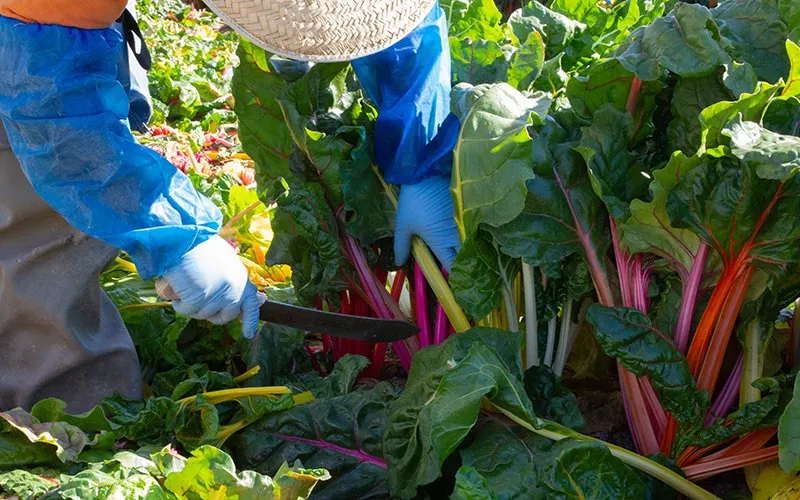
YUMA – The workers swing their machetes, chopping vegetables under the heat of a midmorning sun.
When the migrant workers take a moment to swipe the sweat from their masked faces, they can see the wall along the Mexican border, not a half-mile distant. But before long, they turn their attention back to a rainbow-colored field of Swiss chard.
It takes more time to clear a field since the COVID-19 pandemic began a year ago. Where there had been 25 workers in the field, there are now 15, to create social distance.
More buses are used to drive workers to the fields, and plexiglass guards were placed on farming equipment, according to the Yuma Chamber of Commerce. Some farms have added masks, daily temperature and blood-pressure checks and contact tracing after outbreaks.
The protocols were necessary to protect Yuma’s top industry, which depends on migrant workers – whom Gov. Doug Ducey declared essential when the pandemic began more than a year ago. Yuma is one of the nation’s major producers of vegetables, with the produce ending up in kitchens across the U.S.
Now, attention is turning to getting farmworkers vaccinated, but advocates for migrant workers say that effort trails the need.
Migrant workers – close to 9,000 temporary agricultural worker visas were issued in Arizona during 2020, mostly in Yuma – travel across the border every day from Mexico.
The Yuma Chamber of Commerce website says agriculture brings in an estimated $2.5 billion a year into the local economy.
Still, some farmworkers are nervous.
More than half a million agricultural workers had tested positive for COVID-19 in the U.S. as of March 10, according to Purdue University’s Food and Agriculture Vulnerability Index. It estimated that just under 7,200 of those cases were in Arizona, about 1,000 of which were in Yuma County.
“When our work partner sneezes, we all turn around,” Teresa De Jesús Rodríguez, a migrant worker in Yuma, said in Spanish. “Outside of work, we ask that person how they feel and make sure we always isolate the person.
Thursday, May 6, 2021


Schools throughout Pima County will offer free summer school programs thanks to an increase in federal funds.
Marana Unified School District expanded its free summer programs, from preschool programs to high school summer recovery programs, for June and July.
“This year, we had a tremendous opportunity to expand our programs with additional grants and Federal funding,” Assistant Superintendent Kristin Reidy said in a prepared statement. “Our teachers have really stepped up and are developing engaging activities and curriculum for students. We encourage our families to take advantage of this extended learning!”
Marana received about $4.7 million in ESSER II funds with about $1 million allocated for MUSD’s Summer Enrichment Programs, which funds staffing for teachers and support service staff across the District, as well as safety and mitigation resources, curriculum activities and resources, and professional collaboration contract hours for teachers, said district spokesperson Alli Benjamin.

