

Thursday, April 15, 2021

With 460 new cases reported today, the total number of Arizona’s confirmed novel coronavirus neared 852,000 as of Thursday, April 15, according to the Arizona Department of Health Services.

Pima County, which reported 126 new cases today, has seen 114,029 of the state’s 851,725 confirmed cases.
With 14 new deaths reported this morning, a total of 17,123 Arizonans have died after contracting COVID-19, including 2,376 deaths in Pima County, according to the April 15 report.
A total of 584 coronavirus patients were in the hospital as of April 14. That’s roughly 11.5% of the number hospitalized at the peak of the winter surge, which reached 5,082 on Jan. 12. The summer peak was 3,517, which was set on July 13, 2020. The subsequent lowest number of hospitalized COVID patients was 468, set on Sept. 27, 2020.
A total of 968 people visited emergency rooms with COVID-like symptoms on April 14. That number represents 41% of the record high of 2,341 set on Tuesday, Dec. 29, 2020. That number had peaked during the summer wave at 2,008 on July 7, 2020; it hit a subsequent low of 653 on Sept. 28, 2020.
A total of 162 COVID-19 patients were in intensive care unit beds on April 14, which roughly 13.5% of the record 1,183 ICU patients set on Jan. 11. The summer’s record number of patients in ICU beds was 970, set on July 13, 2020. The subsequent low was 114 on Sept. 22, 2020.

PHOENIX – Nicole Minnick had been a firefighter for seven years when she gave birth in 2008 to her first child, a girl named Kyndal. A few months later, when she returned to work, one thought was foremost in her mind: Would it be safe to breastfeed?
“My second or third shift back to work, we had a fire – and my baby’s 3 months old. I was like, ‘Well I probably shouldn’t nurse her. How long do I need to pump and dump?’” Minnick recalled. “I called the fire department, and they had no idea.”
Turns out extensive research to determine how long carcinogens remain in the breast milk of female firefighters had never been conducted, prompting Minnick to take part in a University of Arizona study.
“This was my baby,” she said. “I wanted to know.”
Now a new UA study aims to build on that body of work and further understand the occupational risks unique to women in the fire service.
The three-year study, funded by a $1.5 million grant from the Federal Emergency Management Agency, will explore stress, cancer risks and the effect of toxins on reproductive health. Researchers hope to enlist 200 women – 100 incumbent firefighters and 100 new recruits – from departments across the U.S., including some from the Tucson Fire Department.
Comparing new recruits with those who’ve served for some years will help identify potential differences in stress and markers in blood associated with increased cancer risk.
“The women and men of the fire service are keeping those of us in the public safe, and therefore it’s really important that we help them by providing information that they can use to keep themselves safe,” said Dr. Jeff Burgess, associate dean for research at the University of Arizona’s College of Public Health.
The project includes a “virtual kitchen table” to provide mentorship for female firefighters with a goal of building resilience and reducing stress. The idea, researcher Sara Jahnke said, is to form an official research question around “What do you need to be supported?”

Wednesday, April 14, 2021
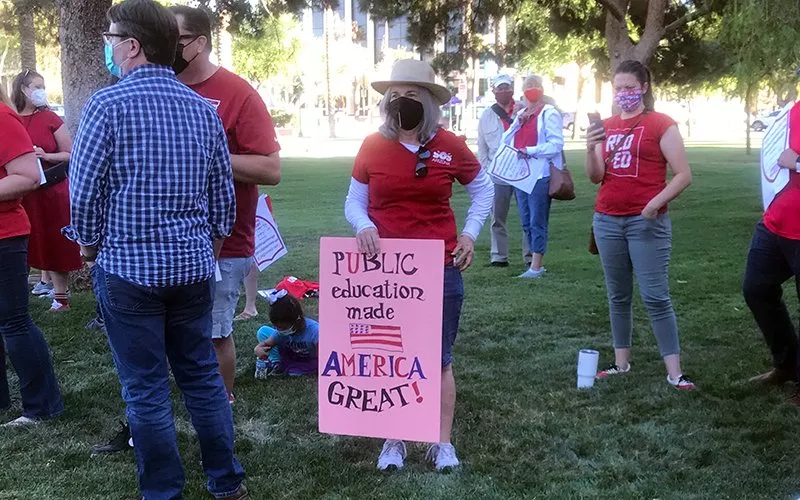
PHOENIX – Red for Ed, the teachers group that spearheaded Proposition 208 – which increases some taxes to hire teachers and bolster teacher salaries – returned to the political battlefield to fight a bill it says undermines the will of Arizona voters in November.
Education advocates oppose Senate Bill 1783, which would allow some business owners to avoid paying the higher taxes Proposition 208 levies on Arizona’s wealthiest residents. Proposition 208, approved by voters 52% to 48%, was spawned by the Red for Ed movement, which formed in 2018 to demand additional funds for education. Arizona ranks 50th in teacher pay, according to Expect More Arizona, an education group.
“This is about the kids and making sure that they have the brightest future possible,” Rebecca Gau, executive director of Stand for Children, said at a rally at the state Capitol last week.
Proposition 208 levies a 3.5% surcharge on the current rate of 4.5% on income exceeding $250,000 for single earners or $500,000 for couples. But SB 1783, sponsored by Sen. J.D. Mesnard, R-Chandler, would circumvent the surcharge by creating an alternate tax category, according to Capitol Media Services.
Mesnard told Capitol Media that the measure would help small businesses.
“We heard time and time again this will not or is not meant to impact small businesses,” he said. “And so what this is doing is ensuring that’s the case.”
About a dozen teachers, parents and students came to the Capitol to show their support for schools. Dressed in red or blue T-shirts, several carried signs. “Education made America great,” one said. “Seriously, do we really need to do this again?” said another.
The Kino COVID-19 vaccination drive-through site will shut down permanently after delivering its last doses on May 14, due to hot weather, Pima County officials announced on Tuesday.
The site at Kino Stadium managed by Banner – University Medicine will begin and end earlier starting on April 17. The new hours will be 7:30 a.m. to 12:30 p.m., Monday through Saturday, in order to keep people out of the heat. After April 17, the site will be administering only second doses. Patients will be notified by Banner directly if their appointment times need to change due to the shift.
"We're grateful to Banner for their collaboration with Pima County in getting so many shots in arms quickly and efficiently," said Pima County Health Director Dr. Theresa Cullen. "The County exceeded its early vaccination goals and has worked with partners to expand indoor operations and keep the momentum going."
In preparation for the shift, on April 12, the county opened an indoor facility at Kino Event Center on the northside of Ajo Way. First- and second-dose appointments can be made at podvaccine.azdhs.gov.
Banner has administered more than 140,000 doses of Moderna and Pfizer vaccines within Pima County since December 2020.
“It has been our pleasure to partner with Pima County on this very important effort,” said Sara Frost, chief executive officer of Banner – University Medical Center Tucson and South. “We will provide ongoing support to the health department as they continue their vaccination efforts in Pima County, and we hope all community residents will choose to get the vaccine when it is your turn.”
For vaccine information and registration options in Pima County, go to www.pima.gov/covid19vaccine.
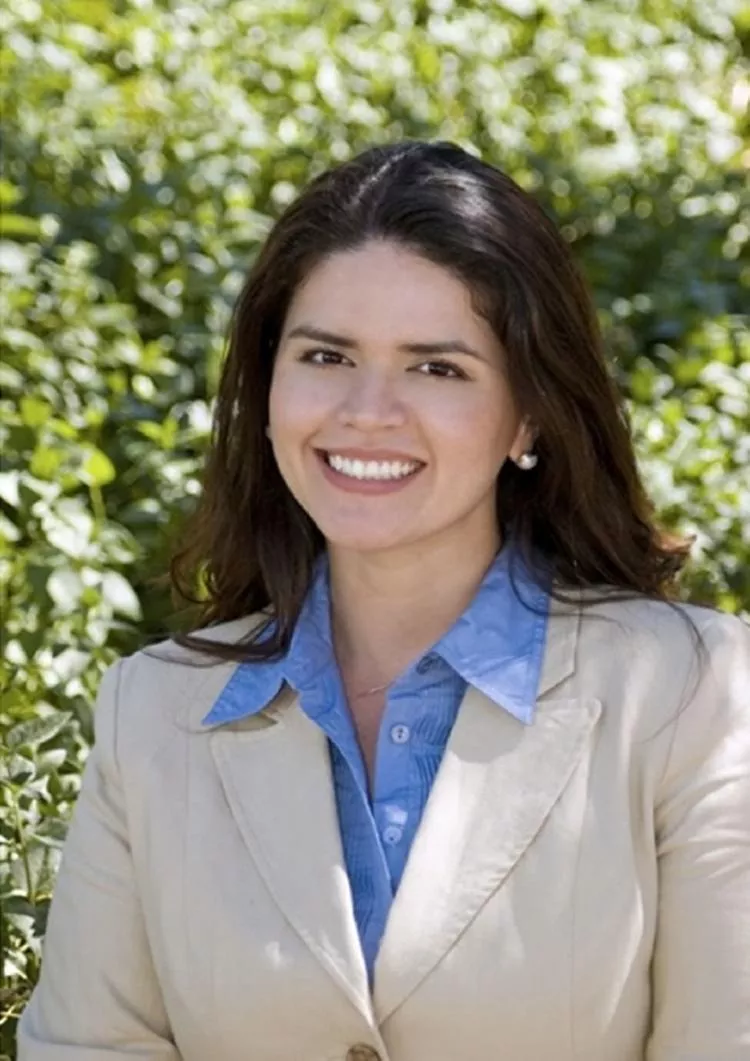
The Arizona Supreme Court today said state lawmakers overreached when they passed a law requiring Tucson elections to move to presidential and midterm election years if not enough voters turned out to cast ballots.
In a 5-1 decision with Justice Clint Bolick dissenting, the court held that the timing of elections in a charter city such as Tucson was not a matter of statewide concerns, no matter the level of participation.
"Whether to align municipal elections with state and national elections or hold them in different years is purely a matter of municipal interest and not a statewide concern," Vice Chief Justice Ann A. Scott Timmer wrote for the majority. "Consequently, we hold that (the statute) cannot apply to require a city to consolidate local elections with state and national elections if its charter provides otherwise."
The 2018 law would have triggered a change in the schedule if turnout in a city election fell by 25% or more from the previous year's gubernatorial election. The Tucson City Council asked voters to amend the charter in 2018, but the proposition was rejected and the City Council does not have the power to override charter provisions without voter approval.
Attorney general Mark Brnovich then petitioned the Arizona Supreme Court to resolved the issue.
As a result of the ruling, this year's city election will continue as scheduled, with elections in Wards 3, 5 and 6.
Tucson Mayor Regina Romero cheered the decision.
“I am pleased that the Arizona Supreme Court agreed with the City of Tucson that our local elections are a matter of local concern,” Romero said. “Phoenix state legislators have once again failed to override the will of Tucsonans in disrupting our local elections. Tucsonans have repeatedly affirmed that our local elections belong on odd years, which allows for city-focused campaigns and robust public discourse on local issues that would otherwise be overshadowed by federal and state elections on even years. I hope that this ruling finally puts the issue to rest, and that our State Legislators can return their focus to the pressing issues facing Arizonans instead of meddling with our local elections.”
State lawmakers already forced smaller towns without protected charter rights to move their elections in sync with the presidential and midterm elections as of 2014. But the Arizona Supreme ruled that law did not apply to Tucson for similar reasons.
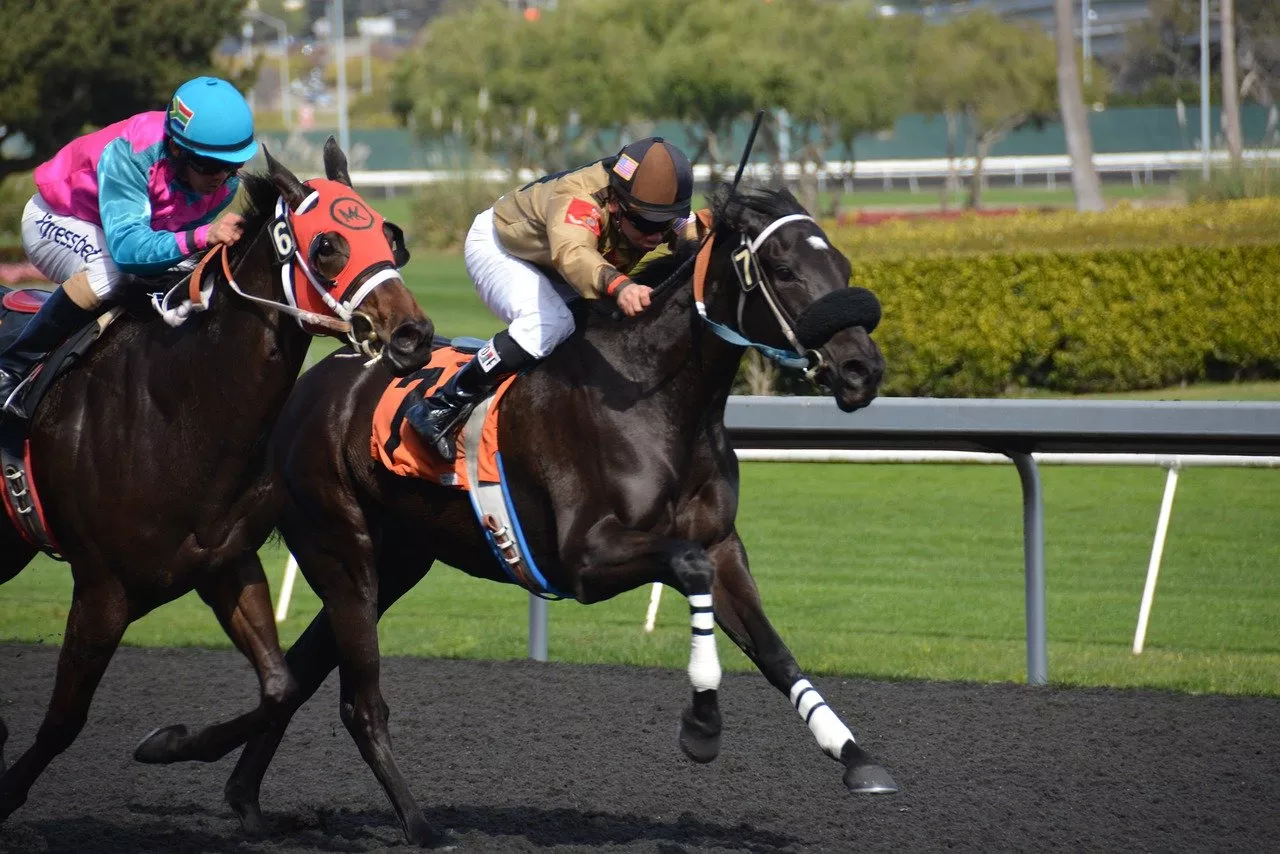
PHOENIX – The Arizona Senate passed legislation Monday night that paves the way for legalized sports betting in the state, possibly as soon as summer.
Senate Bill 1797 and House Bill 2772 were passed with bipartisan support on the new gaming compact, which includes the legalization of daily fantasy sports, and now head to Gov. Doug Ducey to be signed into law. The bill includes an emergency clause, which would enact the changes immediately if Ducey signs the bill.
“We could possibly begin gambling and wagering on sporting events as the Cardinals kick their season off this fall,” said Sen. T.J. Shope, R-Coolidge. “That has been our aspirational goal from the beginning. It is my hope that we’ll go ahead and achieve that.”
Included in the agreement, 10 licenses would be granted by the state to sports organizations. They would have the ability to create their own sportsbooks within their respective venues. Golf courses, race tracks and other sports arenas would have the ability to apply and use one of these licenses.
Another 10 licenses would be provided to Native American tribes throughout the state to create a sportsbook at their respective casinos.
Co-sponsors of this bill – Shope and Rep. Jeff Weninger, R-Chandler – have been working directly with the Governor’s Office for a number of years to get sports betting legalized.

With 419 new cases reported today, the total number of Arizona’s confirmed novel coronavirus cases passed 851,000 as of Wednesday, April 14, according to the Arizona Department of Health Services

Pima County, which reported 81 new cases today, has seen 113,903 of the state’s 851,265 confirmed cases.
With 4 new deaths reported this morning, a total of 17,109 Arizonans have died after contracting COVID-19, including 2,372 deaths in Pima County, according to the April 14 report.
A total of 531 coronavirus patients were in the hospital as of April 13. That’s roughly 22.5% of the number hospitalized at the peak of the winter surge, which reached 5,082 on Jan. 12. The summer peak was 3,517, which was set on July 13, 2020. The subsequent lowest number of hospitalized COVID patients was 468, set on Sept. 27, 2020.
A total of 984 people visited emergency rooms with COVID-like symptoms on April 13. That number represents 42% of the record high of 2,341 set on Tuesday, Dec. 29, 2020. That number had peaked during the summer wave at 2,008 on July 7, 2020; it hit a subsequent low of 653 on Sept. 28, 2020.
A total of 150 COVID-19 patients were in intensive care unit beds on April 13, which roughly 12.5% of the record 1,183 ICU patients set on Jan. 11. The summer’s record number of patients in ICU beds was 970, set on July 13, 2020. The subsequent low was 114 on Sept. 22, 2020.
County halts use of J&J vaccine
Pima County Health Department is temporarily pausing the distribution of Johnson & Johnson vaccine on the guidance and recommendation from the CDC and Arizona Department of Health Services on Tuesday.

