
Monday, April 5, 2021

In 2020, Lea Márquez Peterson and Anna Tovar became the first Latinas elected to statewide office in Arizona. They serve on the Arizona Corporation Commission.
PHOENIX – Esme Franco Ruiz is passionate about her work in politics – even though she despises politics.
“I don’t like politics because it tends to be very, very shady,” she said. “I don’t appreciate how it’s a popularity contest of sorts. There’s not really an importance put into actually informing people; it’s more like people are just trying to get your vote with any means possible.”
Ruiz, a sophomore at Arizona State University who’s double majoring in transborder studies and Spanish, also is the board secretary for Aliento @ ASU, a youth-led organization that advocates for undocumented immigrants.
She spends many afternoons in Phoenix neighborhoods, walking door-to-door putting up flyers about upcoming elections.
Ruiz hopes to put more effort into local elections and candidates who “might not have the spotlight in ways that they should,” including Hispanic politicians.
“One of the reasons that change is so slow is not because we don’t want (Hispanics) in office, but we don’t inform people enough in the Latino community,” she said.
Latina leaders in Arizona
Latinos are a growing force in the nation’s political landscape, even as they lag in election to public office in Arizona and elsewhere. Hispanics account for the nation’s largest ethnic or racial minority and more than half of the total U.S. population growth since 2010, with most of the increases in the Southwest.
Hispanics make up nearly one-third of Arizona’s 7.3 million residents, although their last statewide representative was Raúl Castro, who was elected governor in 1974.
That 46-year drought ended Jan. 4, when Anna Tovar and Lea Márquez Peterson were sworn in as Arizona Corporation Commissioners – Márquez Peterson as the chair – and became the first Latinas elected to statewide office in Arizona. They also were the only identified Latinas in the country to win a position in statewide elected executive office in 2020.

Sunday, April 4, 2021
Saturday, April 3, 2021

Friday, April 2, 2021
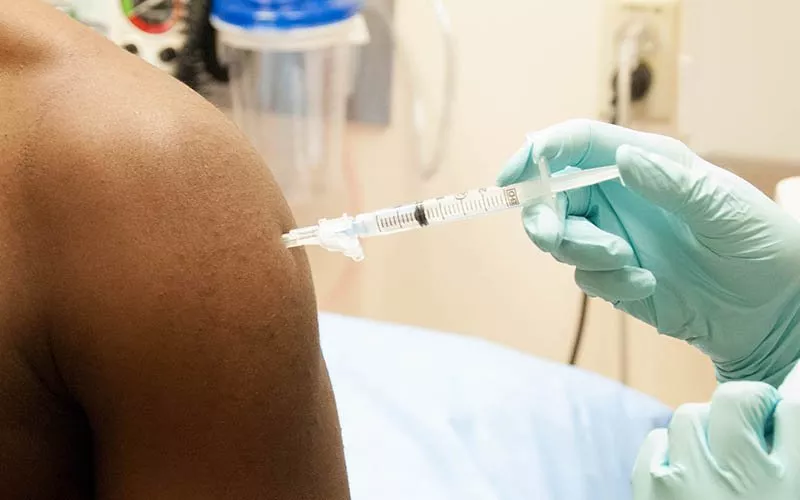
If you're free this afternoon and haven't had luck scheduling an appointment for your COVID vaccine, the University of Arizona's state COVID-19 vaccination POD has about 1,500 appointments open today between 2-6 p.m.
People must register for an appointment online at podvaccine.azdhs.gov or call 602-542-1000 or 844-542-8201 for help in both Spanish and English.
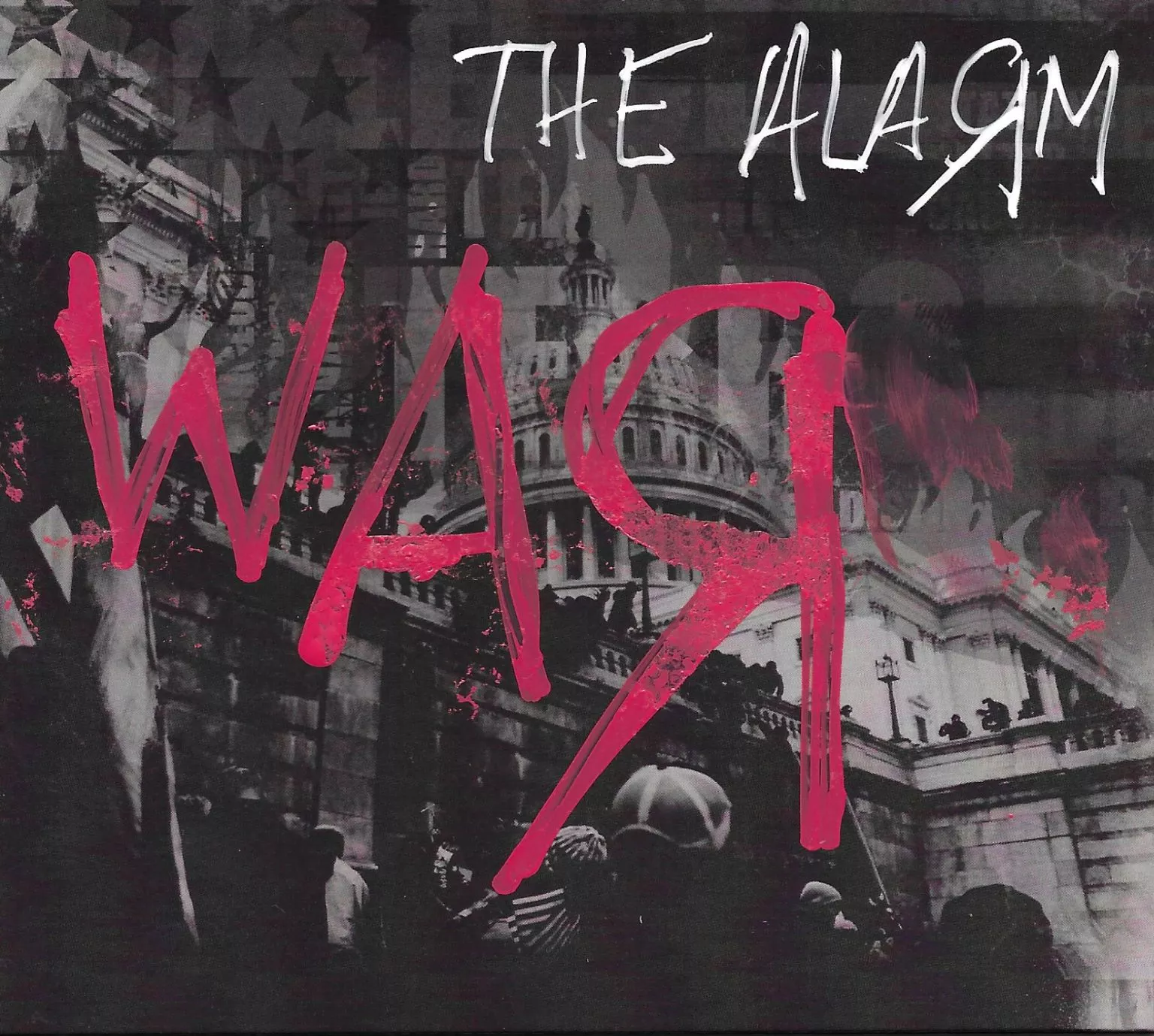
Mike Peters believes there is no time like the present to take on unprecedented battles as a rock ’n’ roll frontman. Yes, that sentence contains both “battles” and “rock ’n’ roll.” See, it’s like the founder-frontman of the Welsh post-punks The Alarm is still a kid at home with Dylan, P.F. Sloan and Clash sides, burning with desire to write and sing of the world around him.
That might be too easy. Remember, Peters so far has made a career of overcoming obstacles, both career-wise and the death-defying personal. For starters, he led his band to rise, fall hard and rise again. Alarm songs like “The Stand,” “Blaze of Glory,” “68 Guns” and “Spirit of 76” from the band’s initial line-up (1981-1991) are all fist-jacking sing-alongs with surprising songwriterly roots, easily traced back to the great folk-shouters. And, yes, Peters’ earnestness was all very Bono and Strummer, but his had the kid-like innocence of a schoolyard history nerd dressed up in cowboy boots, a bolo tie and rats-nest hair. The band got a pass because the anti-racist, pro-working-class songs were so damn good. (They even released one of the era’s most beautiful moments in “Rain in the Summertime.”)
That version of The Alarm nearly broke wide-open in America, and their albums all charted worldwide. But one night at UK’s Brixton Academy ’91, Peters up and left the band. This after recording the fifth album RAW, a lame-duck obligation with IRS Records. The foursome’s (Peters, bassist Eddie McDonald, guitarist Dave Sharp, drummer Nigel Twist) run to document topical and political events in pop songs, and the nurturing relationship with a re-energized Neil Young, had failed.
After some soul-searching and solo work, and, later, a stop in a reformed Big Country, Peters then rebuilt the band from scratch. The Alarm now contains former Gen X, The Cult and Kim Wilde guitar-hero James Stevenson, well-known U.K. drummer Steve “Smiley” Bernard, and Peters’ wife, keyboardist Jules Jones Peters.
In his life personal life, Peters, the father of two boys, had defeated non-Hodgkin's lymphoma in 1996, leukemia in 2005 and a relapse a decade later. His wife Jules beat breast cancer. From that, he and Jules created the worldwide Love Hope Strength Foundation, with partner/cancer survivor James Chippendale. In short, it is a charity to raise funds and awareness to benefit people with cancer and leukemia. The charity is successful, boasting a quarter-million registrants, and 4500 stem-cell donor matches. Peters’ motto? “Saving lives one concert at a time.”
The guy is one resilient dude, always has been, possessed of a never-say-die confidence, and more comebacks than The Italian Stallion. And here he goes again.
The Alarm’s new album, WAR (the band’s 18th!) was completely birthed in isolation — written, rehearsed, recorded (mostly remotely, files exchanged with other Alarm members), and distributed in 50 days during the quarantine-like state of the world, a timely response and calling to a world shuttered from disease.
COVID-19 wasn’t enough for Peters; his breaking point was ever-ugly Trump, and his coup attempt on American democracy in January. The album began the morning after the Capitol attack. (Peters had actually already written another album with sights on release once the world opened, but that was shelved for WAR.)
Get this: WAR (on Peters’ own Twenty First Century Recording Company) first arrived in blank CD-Rs (without the music) mailed to pre-orderers in advance. This allowed fans to burn the files that were soon sent them. The project is pretty unprecedented too. The band recorded each step of the project beginning January 7, starting with Zoom meetings with band members and producer George Williams. The daily video exchanges were viewed by fans all over the world via The Alarm website, essentially making them a piece of the album’s birth as well as studio spectators.
Peters and the band laid final WAR touches in the legendary Rockfield studios, and performed the 10-song album in its entirety, in customized safe social-distance work-arounds with see-through panels separating band members—even for the final vocals on the album’s sole cover (Massive Attack’s “Safe from Harm”), a duet with Welshman Benji Webbe of raga ragers Skindred.
The album is a tight, sonic stand against the handling of the pandemic and the U.S. Capitol riots. It’s like rock ’n’ roll never went anywhere, and this is its welcome, slogan-fortified protest music. Peters sounds as youthful as ever.
Opener “Protect and Survive” amps up on foreboding keys and drums, menacing guitars, and soaring Peters’ vocals that recall Neil Young in a fervor. Up-tempo anthem “We Got This” collides Zep with something like STP, and early Alarm; “Fail” finger-pistols the political divisiveness inspired by the Capitol attacks, a crafty reggae-lit verse and a pop chorus that’d do Mick Jones proud. “Warriors” is all four-on-the-floor pounding juxtaposed against heavy open-space guitars and a giant, key-change chorus emphasizing a “drone attack.’ Coup de gras, Massive Attacks “Safe from Harm” rocks and funks with all the grace of a ballad cranked out at 11, Webbe’s ominous growls underscore Peters' melodic cries of self-determination and autonomy like some late-night sonic noir, good versus evil.
The album is out now, streaming and physical. Peters also hand-painted a limited number of collectible WAR vinyl for purchase.
Tucson Weekly spoke with Peters via Zoom recently and discussed the pandemic, how Capitol riots influenced WAR’s creation, the video journal viewing of the entire process, the “Staycation” shows in Dyserth, where Peters and family reside, and putting out a social-distancing album by his 62nd birthday.
Tucson Weekly: When did the moment to record a new album really hit you?
Mike Peters: It literally happened straight away on the night the Capitol building was being occupied. I was actually on the phone with a friend of mine [D.C. lawyer and Love Hope Strength Foundation board member Elliot Berke]. He represents some pretty high-up politicians on both sides of the divide. And when people started storming the Capitol building it was happening in front of us. I kept seeing the headlines, “Alarming news, the Capitol is being occupied.”
I just thought, “Wow, we’ve got to write now. I’ve got to write a record that captures what’s going on at this very, very moment, and release it while it’s happening. If we do it retrospectively, it might not have the same impact.” I wanted a record people could put on the turntable, listen headphones, but we’re still in lockdown, or still facing the challenges that the pandemic has brought into all our lives.
TW: The Clash recorded “White Riot” to bring attention to race riots and police brutality, and the 1979 overtaking of the Nicaraguan dictatorship-run government, inspired The Clash’s Sandinista. Why is it important to get this album out in the here-and-now with that same mindset?
Peters: When the Sex Pistols released “God Save the Queen,” it was the Queen’s (Silver) Jubilee year; it wouldn’t have been the same a year later.
When the Clash put out “White Riot” the race riots were happening in the streets, all around London. It was in Notting Hill, and it was immediate music, and Jules had bought me the John Lennon “Give Me Some Truth” compilation of remixes, when you can really hear his voice in the foreground. And I was reading about “Instant Karma,” which Lennon said he’d written for breakfast, recorded for lunch and released it for dinner. And I said, we need to make a record with that kind of spirit behind it, and that’s what led to this whole project.
TW: Can you walk us through the process of this unique, yet time-sensitive process?
Peters: To get the record out on my birthday, Thursday, February 25th, at midnight on the 26th, to get it round the world on Spotify and iTunes and all the digitals, I had to have the record done by Monday morning. I could also then on Monday morning give it to the guy who was hand-cutting all the vinyl LPs, to get a head start. And get the CDs loaded for people because we sent a lot of CDRs out to America and Australia for people who wanted to have a physical copy of the album the day it came out, so we digitally sent them all the tracks, so it’s been quite a project. A lot of outside-the-box thinking.
TW: The ’91 Alarm album RAW was more or less the fulfilling of your IRS contract. Was this the bucket-list opportunity the alluded the band in 1991?
Peters: I always felt in ’91 we missed an opportunity to re-define the band’s stance and platform to face the future. Nirvana had come along, Pearl Jam; it was a whole new musical landscape. That was one of the trigger points.
So, we ended up making a lot of compromises on RAW with who sang, and who wrote, in rather than just writing about the Gulf War and the change of the times. So, I always felt we missed an opportunity, and I saw the Capitol building being occupied, I thought, “here’s the moment I can take that opportunity and do something with it.”
TW: What was the impetus behind journaling the process for fans and public consumption, and when did that come about?
Peters: What actually happened was as soon as I woke up in the morning [after seeing the Capitol riots] I didn’t even speak to anybody in the band. I didn’t speak to Jules. If I speak to people about this notion of making an album starting today, that I’m gonna put out on my birthday, everyone will talk me out of it. So, I literally when onto The Alarm website; I wrote my letter to everyone: “It’s time to make a record,” and that was it.
Jules saw it pop up on The Alarm website and said, “What are you doing?” I said, “We’re gonna make a record. We can’t let what just happened go by without documenting it in real time and responding to it as a musicians and songwriters. And so, we’re going to make a record now.” So I picked up the phone and called the band, and Jules got her phone out and started filming it straight away. Jules said, “I’m going to keep going. If you’re going to make a record and I’m going to record, and the band is going to see how you come up with these mad schemes of yours.” When I sat down and thought about it actually, I could have very easily fallen flat on my face if the songs hadn’t come in the way I had hoped. At the same time, there was so much going on in the world, if you can’t write a song now, then there’s no hope. There’s so much sing about, let’s do it.
TW: How different has it been being home with the boys and Jules for all this time, when normally you would be touring?
Peters: The thing I found the most frustrating at first when the lockdown happened was the bombardment of 24-hour news. I knew it was there, it was always in the background. But it wasn’t really until the pandemic hit, the lockdown started to be mentally disturbing; this 24-hour news. We’re going to tune into the main headline news on the BBC at 10 o’clock at night, but that is it. We’re going to disassociate ourselves from it, live in our own little world at home, go for our walks, live in nature and that’s what we are going to immerse ourselves in. And it became beautiful in its own way. We started walking in the woods with our kids, we’d see the flowers come out.
TW: Talk about working with Benji Webbe on Massive Attack’s “Safe from Harm.”
Peters: When I was having our vinyl 24-hour sessions when the lockdown was happening, that song came up and I thought, lyrically, this song is now. “Serious infections and dangerous ...” It’s all there. Benji Webbe popped into my mind. Opposite ends of the racial spectrum, opposite ends of the country. Benji’s from the south (Newport) and I’m from North (Prestatyn). I said, “I love this man, and he sang the whole song, which I wasn’t expecting, and he absolutely killed it, and the harmony was amazing.”
TW: You have always been on the cutting edge of new trends in music, digitally recording and editing, now video-journaling the recording process, you have also made the ultimate in connectivity to fans with Alarm Central found at the Alarm website. Can you expound on this all-encompassing social outlet?
Peters: Alarm Central is a platform that allows me to interact with the fans. We’ve come up to our 40th anniversary, so I’ve got a lot to share. I’ve got a scrapbook form 1974 about my journey to music but it’s gone all the way up to this very day, so, I’ve got a lot to share. It gives me a voice to share a lot about our history. It’s a one-stop website, Facebook, Twitter, Instagram, YouTube, Spotify, all in one and its free, or pay a premium for some exclusives.
TW: As I know you miss touring, but what is your outlook on getting back on the road, and even a return to the U.S.?
Peters: When something’s come around that changes the whole life dynamic like the pandemic has, you just have to look for different solutions. And you know I’m fearful that when touring does come back, the infrastructure’s going to be damaged, and damaged quite severely. It might be difficult for a band like The Alarm to come and play 50 dates across America, ’cause maybe only 20 (venues) survived. It’s going to be quite difficult at first to plan a tour, plan for tour buses, hotels. And venues might not have the same capital to take the risk.

Pima County has opened eligibility for anyone 16 and older starting Monday, April 5, county officials announced Friday morning.
The county's move brings it in line with the state, which opened eligibility to those 16 and over on March 24. In response, Pima County opened eligibility before to those 16 and older with high-risk medical conditions and essential workers.
"We have made great progress in vaccinating those groups and are continuing our efforts to ensure that vulnerable and at-risk populations have access to the vaccine as well," said Pima County Health Department Director Dr. Theresa Cullen in a prepared statement. "With vaccine availability increasing in the county, it's the right time to expand and have the same eligibility requirements no matter where you want to get your shot."
As of Friday, the county has administered 477,426 vaccine doses and vaccinated 193,695 people.
The county is opening another vaccination POD at El Pueblo Center on 101 W. Irvington Road beginning Monday. This walk-in POD will offer on-site registration and will operate from 9:30 a.m. to 1:30 p.m. on Mondays, Wednesdays and Fridays. On Monday, the POD will have 600 doses available.
While the county has expanded eligibility for those 16 and older, only the Pfizer vaccine has been approved for teenagers 16 and 17 years old. Pfizer is available at the state-run site on the University of Arizona campus, at Banner-South and potentially at local pharmacies.
Those under 18 need a parent or legal guardian with them to complete the consent forms or have an accompanying adult bring a notarized letter stating that the parent allows the accompanying adult to complete the consent forms.
To register for an appointment with the county visit www.pima.gov/covid19vaccine or call the support line at 520-222-0119.
With 940 new cases reported today, the total number of Arizona’s confirmed novel coronavirus cases topped 843,000 as of Friday, April 2, according to the Arizona Department of Health Services.
Pima County, which reported 139 new cases today, has seen 112,846 of the state’s 843,132 confirmed cases.
With 12 new deaths reported this morning, a total of 16,989 Arizonans have died after contracting COVID-19, including 2,355 deaths in Pima County, according to the April 2 report.
A total of 572 coronavirus patients were in the hospital as of April 1. That’s roughly 11% of the number hospitalized at the peak of the winter surge, which reached 5,082 on Jan. 11. The summer peak was 3,517, which was set on July 13, 2020. The subsequent lowest number of hospitalized COVID patients was 468, set on Sept. 27, 2020.
A total of 1,007 people visited emergency rooms with COVID-like symptoms on April 1. That number represents 43% of the record high of 2,341 set on Tuesday, Dec. 29, 2020. That number had peaked during the summer wave at 2,008 on July 7, 2020; it hit a subsequent low of 653 on Sept. 28, 2020.
A total of 152 COVID-19 patients were in intensive care unit beds on April 1, which roughly 13% of the record 1,183 ICU patients set on Jan. 11. The summer’s record number of patients in ICU beds was 970, set on July 13, 2020. The subsequent low was 114 on Sept. 22, 2020.
TUSD announces prom, graduation ceremonies will happen this year
Tucson Unified School District announced Wednesday they have authorized senior prom and graduation ceremonies for the Class of 2021.
Graduation ceremonies will be held outside each high school stadium and will follow safety protocols, including masks and physical distancing of 3 to 6 feet apart per CDC guidelines, Each graduate has a limit of four guests, each guest must have a physical ticket.
The graduation will also be on Livestream or Facebook Live, shared by each school.
TUSD Superintendent Dr. Gabriel Trujillo said it's not mandatory, but officials are “strongly encouraging” all seniors to be fully vaccinated, or at least receive the first dose, if applicable, at least two weeks before the event.
Prom will be held outside at each high school with options of hosting prom in a large courtyard, stadium, or soccer field. Tickets will be sold on a pre-sale basis to ensure capacity limits.
Each school will determine whether to offer food, which would be prepackaged or provided by food trucks in a designated area with sanitized tables and handwashing stations located away from the main dance floor.
Trujillo said the activities can safely resume because of the increase in vaccine availability.
When TUSD staff was surveyed three weeks ago, more than half had been vaccinated, Trujillo said, with 4,600 out of 7,800 employees fully vaccinated or at least received their first dose. He estimates this number has probably increased since then. More info here.
Adults older than 16 eligible at state vaccine centers; Pima County expands eligibility to anyone with chronic medical condition
New vaccination appointments at state vaccine PODs will open today at 11 a.m.
You can register for your vaccine appointments at a state POD by visiting pod vaccine.azdhs.gov, and those who need assistance can call 1-844-542-8201.
All adults older than 16 are now eligible for appointments at state vaccination PODs.
Previously, vaccines were limited to people 55 and older as well as frontline workers, educators, first responders and healthcare workers.
As of last week, Pima County expanded COVID-19 vaccine eligibility to anyone 55 and older and anyone older than 16 with at-risk circumstances.
Anyone living with a high-risk medical condition or disability, experiencing homelessness or living in a group setting, or receiving in-home or long-term care can get the vaccine. Some of the high-risk medical conditions include cancer, chronic kidney disease, heart conditions or compromised immunity.
Those in high-risk jobs will also be eligible.
Although the state has expanded eligibility to anyone over 16, Pima County's guidelines had to be limited, said Dr. Theresa Cullen, Health Department director.
“Our decisions are based on the current vaccination rates for 55 and up (which is at 42%), as well as our commitment to ensure ongoing access to vulnerable populations,” Cullen said last week. “We anticipate appointments will be filled quickly and as we move these groups, we look forward to being able to align with the state's recommendations within the next six weeks.”
Those who qualify in Pima County’s priority group of eligible vaccine recipients can register for a vaccine at www.pima.gov/covid19vaccineregistration or by calling 520-222-0119.
Many local pharmacies are now receiving vaccine doses. To find one near you, visit the ADHS website.
Get tested: Pima County has free COVID testing
Pima County is continuing to offer a number of testing centers around town.
You’ll have a nasal swab test at the Kino Event Center (2805 E. Ajo Way) and the Udall Center (7200 E. Tanque Verde Road).
The center at the northside Ellie Towne Flowing Wells Community Center, 1660 W. Ruthrauff Road, involves a saliva test designed by ASU.
Schedule an appointment at these or other drive-thru or pop-up sites at pima.gov/covid19testing.
The University of Arizona’s antibody testing can determine if you have had COVID and now have antibodies. To sign up for testing, visit https://covid19antibodytesting.arizona.edu/home.
—with additional reporting from Austin Counts, Christina Duran, Jeff Gardner and Mike Truelsen

Assistance League of Tucson, a volunteer organization whose mission is “Volunteers working in the Tucson community to help those in need,” faced some grim moments at the outset of the pandemic last year.
The nonprofit saw a dramatic drop in the number of volunteers who are vital to the organization’s operations.
But the organization reacted quickly to the changing conditions brought about by the pandemic.
“We're coming up on our 61st anniversary of helping people, those in need here in Tucson,” said Kim Sterling, Assistance League of Tucson president. “You look ahead and you go, did we do well during the pandemic? Are we going to survive another 60 years and still be here to help out?”
At the start of the pandemic, Sterling said they closed down their thrift shop, which provides about 60 percent of their revenue, with donations and grants providing the rest.
As soon as they closed they began to look at their expenses. In 1959, their founders built up a reserve fund totaling one year’s operating expenses, which they didn’t want to dip into since they could not see the end of the pandemic and worried about the possibility of another disaster, Sterling said.
“We did three things, but we had one goal in mind, keep serving those most in need in the Tucson community,” said Sterling. “So we pivoted our program, we cut costs, and we created new revenue streams.”
Sterling said all five of their programs continued with $190,000 in cuts with the proviso that if revenue increased, funding would return to the programs. They looked to maintain the number of people they served, but reduce the amount provided. Their Starting Over Supplies program required a shift in the way the program operated.
Through the program, the organization works with social workers to provide basic housekeeping supplies and other provisions tailored to individuals who may be experiencing homelessness for the first time or coming out of foster care, said Sterling. So when social service agencies shut down and they could not deliver a kit because they were no longer meeting in person, Sterling said they panicked.