
Monday, February 1, 2021
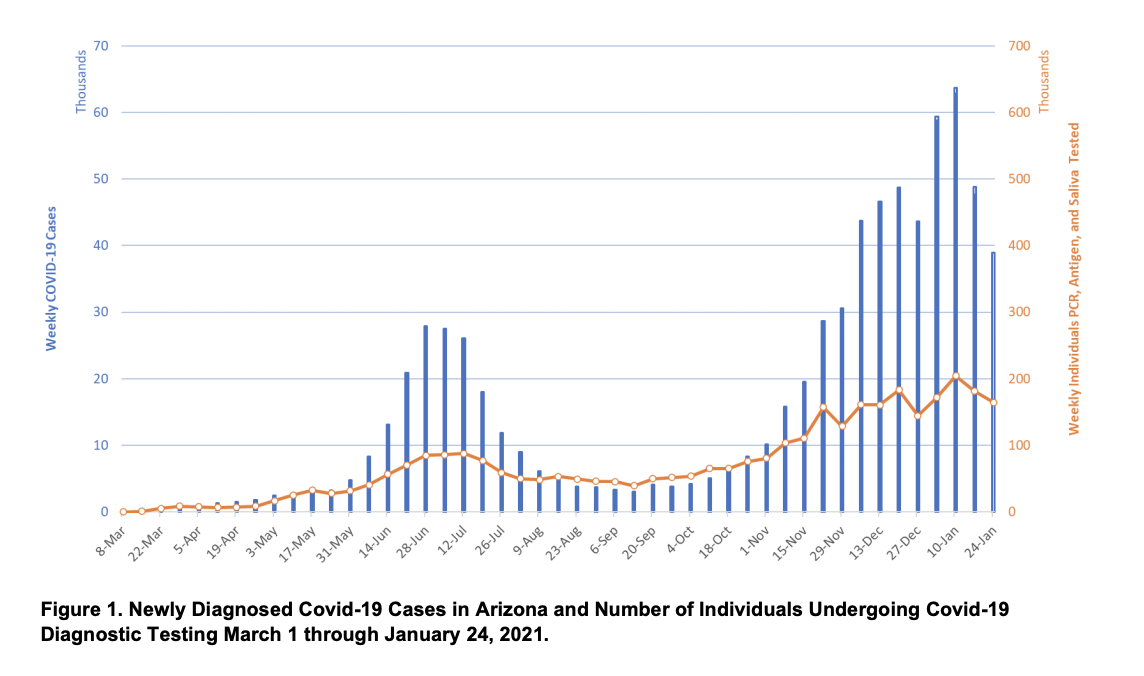
COVID-19 cases have decreased in Arizona for the second week in a row, but the state remains the nation’s highest for transmission of the virus.
CDC data shows Arizona’s average transmission rate is at 75 daily cases per 100,000 population. The state has held the first or second spot through most of January.
The week ending Jan. 24 showed an 18% decrease in coronavirus cases from the previous week prior, according to the latest report by Dr. Joe Gerald, a University of Arizona professor who creates weekly coronavirus epidemiology reports based on Arizona Department of Health Services data.
“This week saw another meaningful decline in COVID-19 cases which now clearly represents a sustained, real decrease in viral transmission,” Gerald wrote in this week’s report. “This decline is accompanied by reductions in hospital and ICU occupancy. Reductions in mortality should quickly follow. While this reprieve is welcomed, the absolute level of [coronavirus] transmission remains exceptionally high.”
The week ending Jan. 10 remains the state’s deadliest with 889 COVID-19 deaths recorded so far. Gerald predicts deaths will remain “exceptionally high” for the next four to six weeks.
Pima County’s outlook
In Pima County, positive cases from the week ending Jan. 17 decreased by 26% since the previous week, Gerald’s report says.
The first week of January saw Pima County’s highest weekly number of COVID-19 cases at 8,814, while the following week dropped to 6,971 and the third week to 4,986, according to the latest Pima County Health Department report. Data from the last 4-7 days are still trickling in, however.
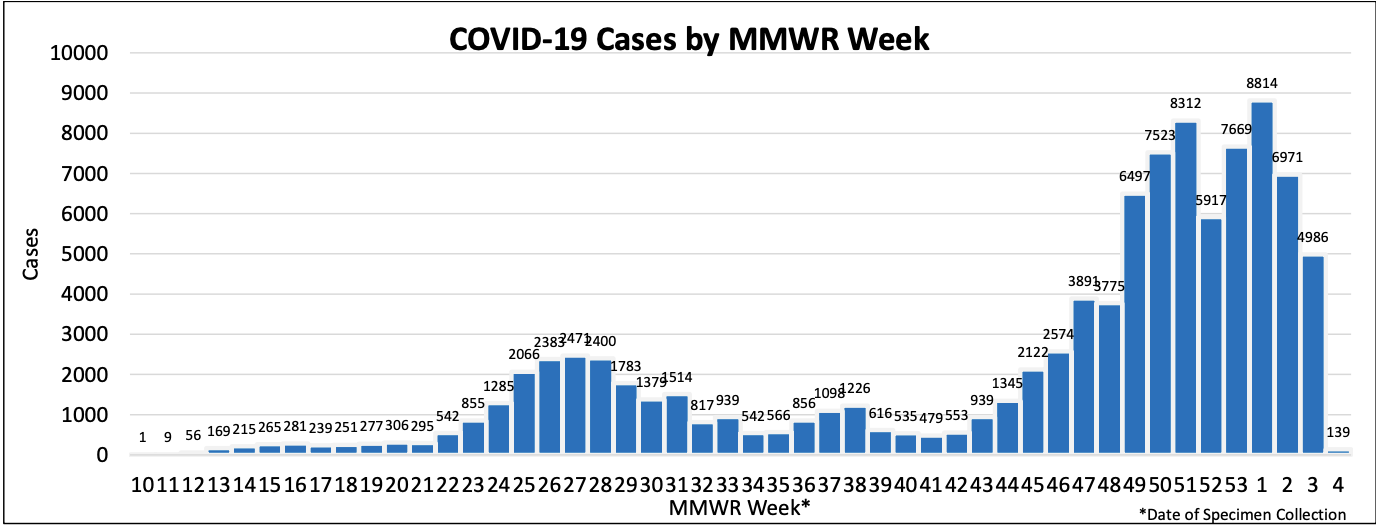
the week ending Jan. 24 shows an 18% decrease in coronavirus cases from the week prior.
Coronavirus deaths in January’s first week tallied 126, the second week 116 and the third week 55, the county reports.
According to Pima County’s Chief Medical Officer Dr. Francisco Garcia, three key indicators tracking the spread of COVID-19 are decreasing throughout the county: cases per 100,000 individuals, percent positivity and hospital visits for COVID-like illness.
This leads him to believe the downward trend in coronavirus cases will sustain.
“All of those are moving in the right direction. If it was going to be short-lived I would expect some of those to not be trending in the same direction,” Garcia said.
However, the trend won’t continue without widespread adherence to virus mitigation practices like mask-wearing, social distancing and frequent sanitization.
“I think we could sustain it if we don't get sloppy again,” Garcia said. “If we continue to do the common sense kinds of mitigation measures that we have tried to reinforce as much as possible, I think we will mitigate against it.”

With nearly 14,000 new cases reported since Friday, the total number of Arizona’s confirmed novel coronavirus cases surpassed 762,000 as of Monday, Feb. 1, according to the Arizona Department of Health Services.

Pima County, which reported 504 new cases today, has seen 101,961 of the state’s 762,145 confirmed cases.
A total of 13,124 Arizonans have died after contracting COVID-19, including 1,740 deaths in Pima County, according to the Feb. 1 report.
The number of hospitalized COVID cases statewide has declined in recent weeks after peaking at 5,082 on Jan. 11 but remains above the peak levels of the summer’s first wave. ADHS reported that as of Jan. 31, 3,654 COVID patients were hospitalized in the state. The summer peak of 3,517 hospitalized COVID patients was set on July 13; that number hit a subsequent low of 468 on Sept. 27.
A total of 1,481 people visited emergency rooms on Jan. 31 with COVID symptoms, down from the record high of 2,341 set on Tuesday, Dec. 29, 2020. That number had peaked during the summer wave at 2,008 on July 7, 2020; it hit a subsequent low of 653 on Sept. 28, 2020.
A total of 984 COVID-19 patients were in intensive care unit beds on Jan. 31, down from a peak of 1,183 set on Jan. 11. The summer’s record number of patients in ICU beds was 970, set on July 13, 2020. The subsequent low was 114 on Sept. 22, 2020.
Pima County passes 100K vaccination threshold
Pima County has passed the paradoxical intersection of administering more than 100,000 COVID-19 vaccines after surpassing 100,000 coronavirus cases Friday.
As of Sunday, Jan. 31, the county administered 112,692 vaccine doses and reported 101,961 coronavirus cases Monday, according to Arizona Department of Health Services data.
“Our vaccination plan was really designed to increase early impact through accelerated immunization,” said Dr. Theresa Cullen, the county’s public health director. “The good news is I think we are starting to see that acceleration, and hopefully, we will soon start to see the impact of that on our community in terms of morbidity and mortality.”
The population currently eligible to receive vaccines are those over 75, educators, childcare providers and protective service workers—a group Cullen estimates to be around 150,000 individuals.
According to the public health director, the county is administering about 35,000 doses a week, which puts them on track to administer 140,000 vaccines by the second week of February.
However, with second doses of either the Pfizer of Moderna vaccine needed for one to be considered fully immunized, Cullen said this doesn’t mean the current 1B priority group in Pima County’s vaccine rollout will be done so soon.
“One would think in four weeks we'd be done, right? Because not everybody's going to get the vaccine. Remember, people are getting two vaccines. So once we throw that second vaccine in there, the numbers become a little extended in terms of how long it takes,” she said.
The next eligible group will be the 65+ population, which Cullen estimates is a group of more than 200,000 residents. Although the current priority group still needs to receive second doses, the 65 and over crowd could be eligible sooner than expected.
“The question everybody wants is when are we going to flip the switch? I would reassure you that we're in the process of doing some calculations, and some of it is related to that second shot,” Cullen said. “But it'll definitely be sometime in February, maybe the end of February. We thought maybe the middle of March—I think it will be earlier if our vaccine distribution holds.”
WASHINGTON – President Joe Biden’s order that the Justice Department stop contracting with private prisons could eventually affect thousands of inmates – but not the roughly 3,000 immigrants being held in private facilities in Arizona.
Biden said Tuesday that his executive order is part of an effort to promote racial equity and is needed to “stop corporations from profiteering off of incarcerating” people in facilities that he said are less humane and less safe.
But the order only applies to the Justice Department, which contracts with private firms to operate 12 prisons housing about 14,000 inmates nationwide. It does not affect Immigration and Customs Enforcement contracts with companies that hold immigrants awaiting hearings or deportation.
ICE’s Phoenix field office has contracts to hold immigrants at four facilities in Arizona: the Central Arizona and Eloy detention centers and the Florence and La Palma correctional centers, all run by CoreCivic Inc. The average daily detainee population for those units combined was 3,070 at the end of fiscal 2020, according to ICE data.

Friday, January 29, 2021
PHOENIX – Anthony Gilich remembers March 16, 2020, the day when the National Junior College Athletic Association announced it was canceling the remainder of the spring sports seasons because of COVID-19.
The Central Arizona College baseball coach, now in his seventh year, had to tell his players something he never thought he would have to say – their season was over.
“It was one of the worst moments I’ve probably had as a coach to be honest with you,” Gilich said. “There is no way to sugarcoat (it).”
Yavapai baseball coach Ryan Cougill also remembers that day vividly.
“It was one of the worst things I’ve had to do,” Cougill said. “It was made worse because I didn’t get to do it in person.”
Before the pandemic cut its season short, Central Arizona looked to repeat as NJCAA Division I World Series champions from 2019, while Yavapai hoped to build on a 22-3 start.
Over 10 months have passed and with less than a week until the beginning of their spring seasons, two of the best Arizona junior college baseball programs are gearing up for a unique season under the COVID-19 umbrella.
Central Arizona and Yavapai,two talented ball clubs playing under the Arizona Community College Athletic Conference (ACCAC), both have been ranked in the Top 25 in numerous preseason polls, including Perfect Game and Collegiate Baseball.

A judge has rejected Pima County's efforts to reinstate its mandatory curfew that was temporarily halted after it was challenged by local bars.
A group of Tucson bars sued the county for the harm they faced from the 10 p.m. to 5 a.m. curfew and was granted a preliminary injunction on Jan. 19 preventing the county from enforcing it.
Owners of Cobra Arcade Bar, HighWire Lounge and The Maverick filed a joint lawsuit on Jan. 5 contending the county overextended their legal authority to mandate a curfew.
The owner of The Maverick, Grant Krueger, included other Tucson restaurants he owns in the lawsuit: Union Public House, Reforma Modern Mexican and Proof Artisanal Pizza & Pasta.
On Jan. 22, the county responded with a motion that would allow them to continue the curfew, but Pima County Superior Court Judge Kellie Johnson denied it on Wednesday.“Defendant argues Plaintiffs’ harms are lessened by the ability to sell food and beverage for offsite consumption even if the curfew is enforced, and their decision not to do so when the curfew was in effect was voluntary. The County also argues its ability to respond to the emergency created by the pandemic is substantially limited if the stay is not granted,” Johnson wrote in the ruling. “The Court considered these arguments in its ruling on the preliminary injunction, and found Plaintiffs demonstrated irreparable harm, and that the balance of hardship tipped in Plaintiffs’ favor.”
The court ordered the preliminary injunction on the grounds the curfew is not “statutorily authorized,” the plaintiffs demonstrated the harm it causes them and it violates Gov. Doug Ducey’s executive order.
The governor’s May 12 executive order states: “...no county, city or town may make or issue any order, rule or regulation that conflicts with or is in addition to the policy, directives or intent of this Executive Order, including but not limited to any order restricting persons from leaving their home due to the COVID-19 public health emergency.”
The curfew was originally set to end when the county reached a rate of 100 COVID-19 cases per 100,000 people. Its current rate is 9,598 cases per 100,000, according to Arizona Department of Health Services data.
The curfew will be halted until a resolution of the case. A trial date has yet to be set.
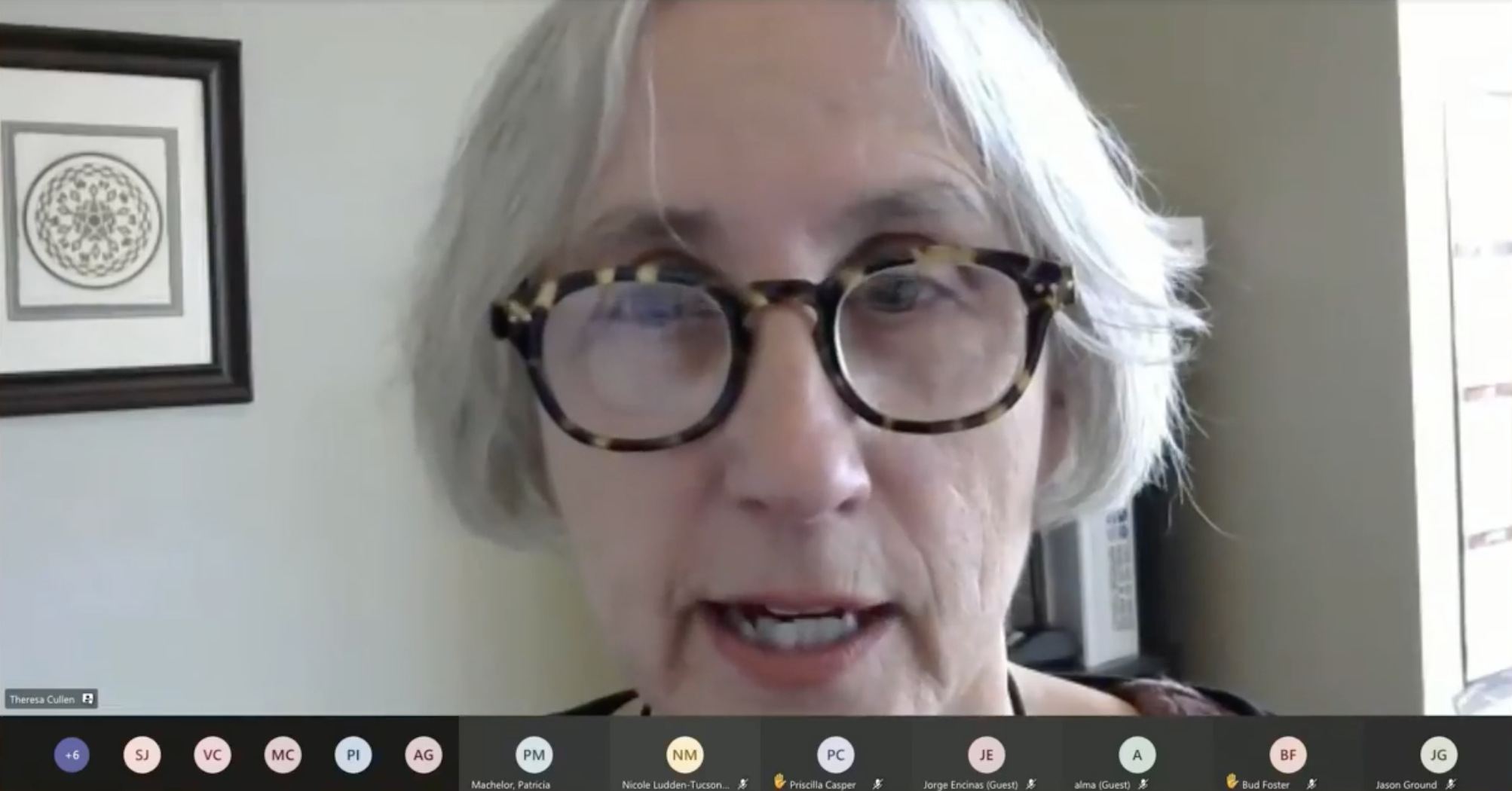
In a matter of days, Pima County is on track to pass the paradoxical intersection of administering 100,000 COVID-19 vaccines after surpassing 100,000 coronavirus cases today.
On Thursday, the county administered 94,370 doses and reported 100,272 coronavirus cases Friday, according to Arizona Department of Health Services data.
“Our vaccination plan was really designed to increase early impact through accelerated immunization,” said Dr. Theresa Cullen, the county’s public health director. “The good news is I think we are starting to see that acceleration, and hopefully, we will soon start to see the impact of that on our community in terms of morbidity and mortality.”
Those 75 and older are eligible for vaccinations, as are educators, childcare providers and protective service workers—a group Cullen estimates to be around 150,000.
According to the public health director, the county is administering about 35,000 doses a week, which puts them on track for 140,000 vaccines by the second week of February.
With the Pfizer and Moderna vaccines needing second doses for full immunization, Cullen said the 1B priority group in Pima County’s vaccine rollout might not be done so soon.
“One would think in four weeks we'd be done, right? Because not everybody's going to get the vaccine. Remember, people are getting two vaccines. So once we throw that second vaccine in there, the numbers become a little extended in terms of how long it takes,” she said.
The next eligible group will be the 65 and older population, which Cullen estimates is a group of more than 200,000. Although the current priority group still needs to receive second doses, the 65 and over crowd could be eligible sooner than expected.
“The question everybody wants is when are we going to flip the switch? I would reassure you that we're in the process of doing some calculations, and some of it is related to that second shot,” Cullen said. “But it'll definitely be sometime in February, maybe the end of February. We thought maybe the middle of March—I think it will be earlier if our vaccine distribution holds.”


With 5,028 new cases reported today, the total number of Arizona’s confirmed novel coronavirus cases surpassed closed in on 750,000 as of Friday, Jan. 29, according to the Arizona Department of Health Services.

Pima County, which reported 698 new cases today, clearing the six-figure threshold, having seen 100,272 of the state’s 748,260 confirmed cases.
A total of 13,022 Arizonans have died after contracting COVID-19, including 1,736 deaths in Pima County, according to the Jan. 29 report.
The number of hospitalized COVID cases statewide has declined in recent weeks after peaking at 5,082 on Jan. 11 but remains above the peak levels of the summer’s first wave. ADHS reported that as of Jan. 28, 3,970 COVID patients were hospitalized in the state. The summer peak of 3,517 hospitalized COVID patients was set on July 13; that number hit a subsequent low of 468 on Sept. 27.
A total of 1,723 people visited emergency rooms on Jan. 28 with COVID symptoms, down from the record high of 2,341 set on Tuesday, Dec. 29, 2020. That number had peaked during the summer wave at 2,008 on July 7; it hit a subsequent low of 653 on Sept. 28.
A total of 1,002 COVID-19 patients were in intensive care unit beds on Jan. 28, down from a peak of 1,183 set on Jan. 11. The summer’s record number of patients in ICU beds was 970, set on July 13. The subsequent low was 114 on Sept. 22.
Despite last week's announcement that COVID-19 cases had decreased and that some elective surgeries would resume, Arizona’s largest hospital system is still caring for more patients than it did during the summer surge.
“Patient care in our hospitals has not yet returned to a state that I would define as usual and customary, and I would caution you against celebrating too early as we slowly work our way out of this difficult surge,” said Banner Health’s Chief Clinical Officer Dr. Marjorie Bessel said at a Wednesday press conference.
Banner is using thousands of out-of-state healthcare workers while upskilling others to help in its ICUs, Bessel said.
The hospital’s forecasting predicts it will take two to three more months for Arizona to fully recover from the winter surge in cases with many more weeks of high numbers of hospitalizations.
Bessel said Banner hospitals frequently monitor the University of Washington’s Institute for Health Metrics and Evaluation tool to grasp likely consequences of COVID-19 in the future.
Estimates predict Arizona will reach 18,500 deaths by May if it continues its current mitigation policies against the virus. If the state eases current mitigations, the death total could reach 22,200 by May, Bessel shared.
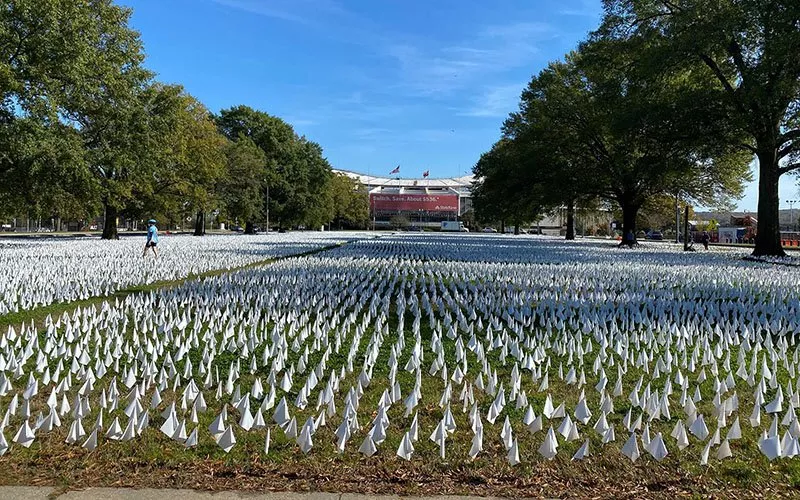
WASHINGTON – Total deaths in Arizona rose 25% in 2020 over the previous year, with some counties seeing increases approaching 50% for the year in which COVID-19 became the leading killer in the state.
While data on the causes of death is not expected until later this year, experts attribute the “exceptional increase” in deaths to the COVID-19 pandemic as well as to fatalities that may be indirectly caused by the pandemic.
“COVID appears to be the reason,” said David Sklar, a professor at Arizona State University’s College of Health Solutions. “Other problems have also increased, such as opioid-related deaths, and some have decreased, such as pedestrian-related deaths because people were driving less and were out less. But COVID has been a large contributor to our increase.”
The Arizona Department of Health Services reported this month that there were 75,133 deaths in the state in 2020, an increase of 24.9% from the 60,161 deaths reported in 2019.
Holly Poynter, a spokesperson for the state health department, said while it’s likely “COVID-19 deaths are a factor” in the increase in deaths, state officials will not be able to say for sure until complete data on cause of death is available later this year.