Monday, October 26, 2020

With 801 new cases reported today, the number of Arizona’s confirmed novel coronavirus cases closed in on 239,000 as of Monday, Oct. 26, according to the Arizona Department of Health Services.

Pima County had seen 27,575 of the state’s 238,964 confirmed cases.
With one new death reported yesterday, a total of 5,875 Arizonans had died after contracting COVID-19, including 636 deaths in Pima County, according to the Oct. 26 report.
The number of hospitalized COVID cases has declined from July peaks but has ticked upward in recent weeks. ADHS reported that as of Oct. 25, 837 COVID patients were hospitalized in the state. That number peaked with 3,517 hospitalized COVID patients on July 13.
A total of 770 people visited emergency rooms on Oct. 25 with COVID symptoms. That number peaked at 2,008 on July 7.
A total of 179 COVID-19 patients were in intensive care unit beds on Oct. 25. The number of COVID patients in ICUs peaked at 970 on July 13.
Although President Donald Trump said the “big spike” in Arizona cases was now “gone” during last week’s final presidential debate, Arizona Department of Health Director Cara Christ noted on her blog last week that cases in the state were on the increase.
Christ wrote that while Arizona has not seen as big a surge as other states, “we have recently seen a shift of COVID-19 spread in the wrong direction.”
Christ noted that the statewide positivity results from tests has climbed from 3.9 percent to 5.5 percent in recent weeks.
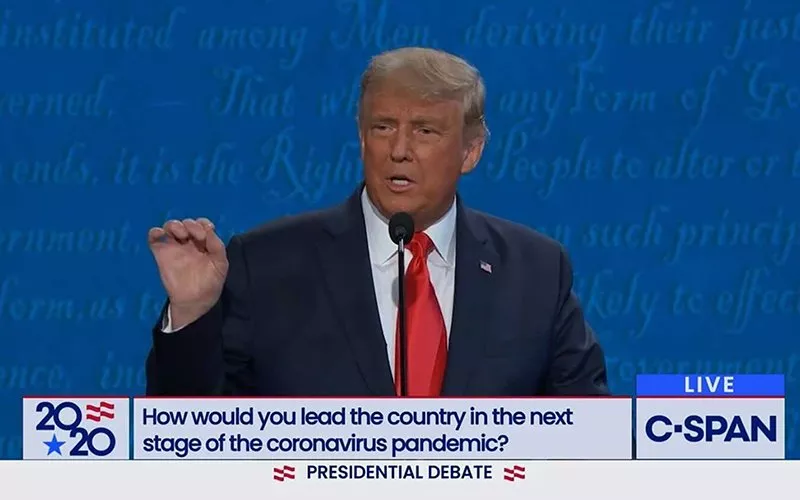
WASHINGTON – President Donald Trump name-dropped Arizona early in Thursday’s presidential debate, claiming the “very big spike” in COVID-19 cases in the state is “now gone.”
Except that it’s not.
New cases are up – twice in the past week they topped 1,000 – the rate of positive tests rose as did hospitalizations – although currently well within the current capacity of hospitals. That led Arizona Department of Health Services director, Dr. Cara Christ, to caution Arizonans on Thursday, “Don’t let down your guard.”
“Over the past few weeks in Arizona, reported cases and percent positivity have been increasing,” Christ wrote in the blog post that went up about an hour before the presidential debate started.
Trump brought up Arizona – and Texas and Florida – early in the debate, when he and Democratic nominee Joe Biden were asked how they would lead the country “during this next stage of the coronavirus.”
Saturday, October 24, 2020
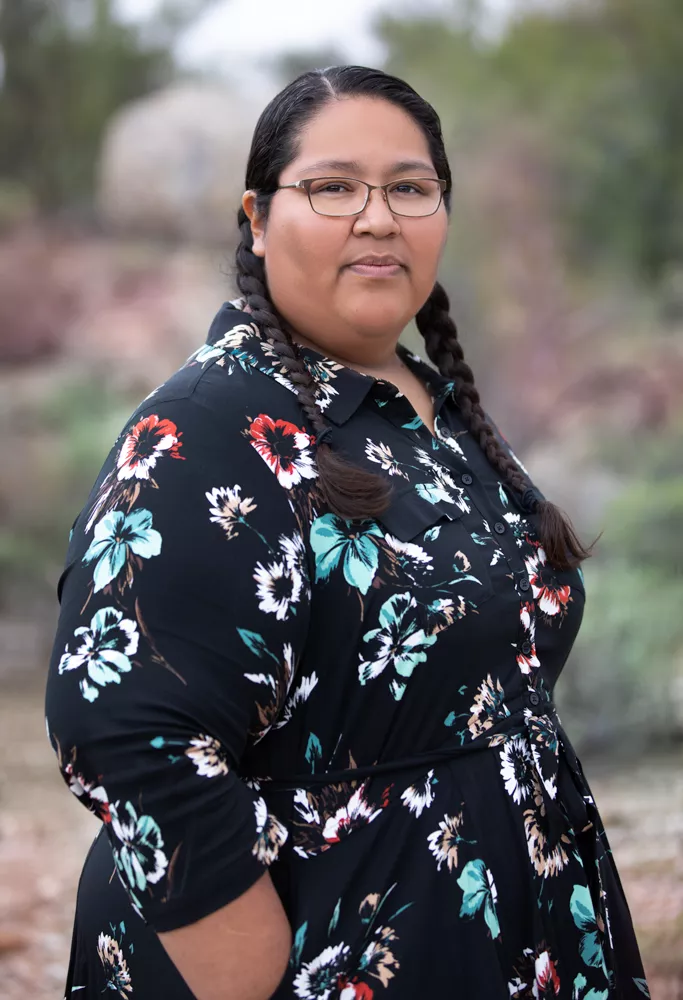
The candidates for Pima County Recorder certainly have different approaches to the office, but one candidate recently criticized the other after third-quarter campaign finance reports were released.
Republican candidate for county recorder Benny White posted a photo of Democratic candidate Gabriella Cázares-Kelly’s cash operating expenses that show she paid herself with campaign funds. The post has since been deleted.
“My opponent pays herself from her campaign account,” the post read. “The saddest part of this in my mind is that she is taking $5 and $10 donations from people who are reported as being unemployed and then taking their money for her own benefit. We just see things differently.”
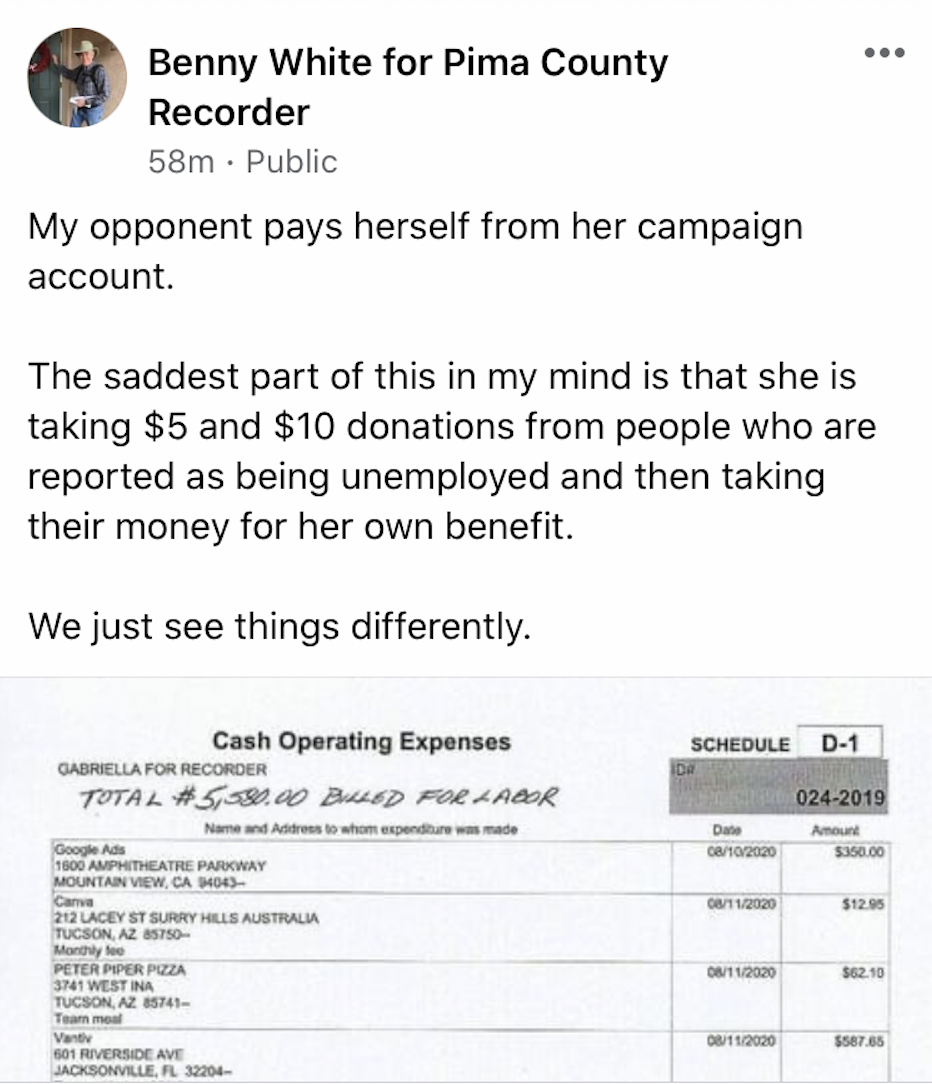
Cázares-Kelly was quick to respond by acknowledging her opponent’s criticism in her own Facebook post and says she pays herself a $1,290 biweekly salary to support herself while she runs for county recorder.
“I do not come from a rich family. I am not independently wealthy, I am not yet retired, and my household cannot survive off of only one income,” she wrote in a Facebook post. “My reality is that I am a working-class candidate bringing my unique perspective and experiences into this leadership role.”
Cázares-Kelly says she paid herself $4,580 in campaign funds from Aug. 19-Sept. 18. One reported expense in the finance report shows a payment of $1,000 on Sept. 2, but her campaign says it was never received, and a later disbursement on Sept. 18 was used in its place.
Her paychecks were set at $1,000 for the first two weeks, and subsequent payments were set at $1,290 a week.
“There is no express prohibition in Arizona on candidates drawing salaries from campaign monies,” Sophia Solis, a spokesperson for the Arizona Secretary of State’s office, wrote in an email.
“Arizona law defines permissible ‘operating expenses’ as ‘staff salaries … and similar items necessary to keep the campaign in operation,’ which could include candidate salaries,” Solis wrote. “While Arizona law applies to local and state candidate campaign finance activities, to the extent that authority from the Federal Election Commission on this issue is persuasive, the FEC permits candidates to draw a limited salary from campaign monies, provided that the salaries do not exceed the lesser of the amount they earned the year prior to running for office, or the minimum salary paid for the office the candidate seeks to hold.”
According to Cázares-Kelly, her salary last year was $54,000 annually. According to Arizona Revised Statutes, the county recorder has a starting salary of $67,800.
“I just found it curious. I've never seen anyone take campaign funds for their personal salary,” county recorder candidate White said. “I don't have any comments on her postings because I've not read them.”
After White made the post on Wednesday, Cázares-Kelly says her campaign has exceeded its fundraising goal.
Within 24 hours of White’s post, Cázares-Kelly says her campaign raised $18,541—the biggest fundraising day of her entire campaign. As of today, the campaign has raised $21,391 online, according to Cázares-Kelly.
“People were very motivated and inspired by the posts that we shared about some of the barriers that I've had being a working-class candidate, and they wanted to show that by donating more money,” Cázares-Kelly said.
Tags: Pima County Recorder , Pima County , Campaign spending , Image
Friday, October 23, 2020

The two-day lineup has been announced for the 2021 Tucson Jazz Festival, which will take place Saturday and Sunday, March 20-21, on the main outdoor stage at Armory Park, 220 S. Fifth Ave.
Saturday will include performances by Nayo Jones, Ghost-Note, Cory Wong, and Dirty Loops. Sunday will feature Pacific Mambo Orchestra, Marcus Miller, Dave Grusin + Lee Ritenour, and St. Paul & The Broken Bones.
Social distancing protocols will be instituted throughout the festival, and face masks will be required for all attendees. Reservations for tickets to the 2021 Tucson Jazz Festival are now available.
The following artist info is from the Tucson Jazz Festival:
NAYO JONES
1 p.m., March 20
Nayo Jones (pronounced Nīyō) is the Chicago-born jazz vocalist based in New Orleans, where she regularly performs with her band, The Nayo Jones Experience. Her vocal range has been compared to Natalie Cole, Nancy Wilson and Whitney Houston. Annually, she can be seen at the New Orleans Jazz & Heritage Festival and French Quarter Fest. She has toured with Kermit Ruffins as the featured vocalist, headlined at various jazz festivals and most recently joined forces with the New Orleans Jazz Orchestra.
GHOST-NOTE
3 p.m., March 20
Ghost-Note is a band with an explosion of sound pushing funk music into the future. Building on the uplifting, pioneering foundations laid out by James Brown and Sly & The Family Stone, they infuse their music with tastes of Afrobeat, hip-hop, psychedelia and more. The band creates seductive, danceable grooves and offers a contagious feel-good energy to ensure their audiences “let loose and connect.”
CORY WONG with Special Guest CODY FRY
5 p.m., March 20
Cory Wong considers himself music’s answer to motivational speakers like Tony Robbins. The NY-born, Minneapolis-raised guitarist attended the University of Minnesota and the McNally Smith College of Music. With head-spinning rhythm guitar wizardry, technical ebullience, and laugh-out-loud jokes, he is both a sought-after collaborator and celebrated solo artist.
DIRTY LOOPS
7 p.m., March 20
Stockholm, Sweden, band Dirty Loops are known for their jazz fusion re-harmonized covers of pop songs like "Baby" by Justin Bieber, "Rolling in the Deep" by Adele, and "Wake Me Up" by Avicii, but don’t let the pop covers fool you. These longtime friends and schoolmates borrow from jazz, jazz fusion, gospel, funk, electronica and disco.
PACIFIC MAMBO ORCHESTRA
1 p.m., March 21
After 10 years of due diligence, the Pacific Mambo Orchestra gained recognition with a crowd-funded, self-titled debut resulting in a GRAMMY for "Best Tropical Latin Album." This San Francisco based orchestra is leading the rebirth of Latin big band music, using the traditions of the classic mambo-craze orchestras of the '50s. While their repertoire consists of mostly original scores they also include clever arrangements of hit songs, performed in English and Spanish.
MARCUS MILLER
3 p.m., March 21
It is said that Marcus Miller has one of the most enviable careers in music, having performed, recorded and toured with legendary artists such as Miles Davis, Dizzy Gillespie, Aretha Franklin, Chaka Khan and Luther Vandross, in addition to working with various rock legends, hip hop icons and pop stars. Marcus Miller is a multi-instrumentalist, albeit primarily known as an electric bassist.
DAVE GRUSIN + LEE RITENOUR
5 p.m., March 21
Dave Grusin, a 10-time Grammy winner, is a seven-decade music professional: pianist, arranger, composer, record producer and co-founder of GRP Records. Grusin is considered one of the top 10 film scorers of his generation, writing more than 60 film scores, including The Graduate, On Golden Pond and The Fabulous Baker Boys, and receiving eight Academy Award nominations and one Oscar.
Grammy winner Lee Ritenour has been a guitarist for six decades beginning with session work in the late '60s. It was in the studio with the Mamas and the Papas that he earned the nickname "Captain Fingers." He has garnered 19 Grammy nominations, #1 spots on guitar polls, a Lifetime Achievement Award from Canadian SJ Awards, Alumnus of the Year Award from USC and 35 chart songs from more than 40 releases.
ST. PAUL & THE BROKEN BONES
7 p.m., March 21
Since forming in 2012, Alabama-based rock & roll soul band, St. Paul & The Broken Bones has released two albums, toured the world relentlessly, opened for the Rolling Stones, and appeared on Letterman. They have become a must-see performance due in part to frontman Paul Janeway’s fearless showmanship, thoughtful lyrics, and dedication to performance. Janeway is supported by co-band leader Jesse Phillips and a full eight-man roster of the best young instrumentalists in the South.

WASHINGTON – After more than a decade of work, $800 million and 200 million miles of space travel, it all came down to six seconds.
That’s how long OSIRIS-REx spent on the surface of near-Earth asteroid Bennu, collecting a small sample of soil before lifting off again for a return trip to Earth. But those six seconds were enough to get University of Arizona researcher Dante Lauretta’s head spinning.
“I must have watched it about 100 times last night before I finally got a little bit of shuteye,” Lauretta said of the video showing the spacecraft’s Touch-And-Go Sample Acquisition Mechanism pushing up a plume of debris from the asteroid’s surface. “And then I dreamed of a wonderworld of Bennu regolith particles floating all around me.”
Lauretta was not the only one hailing the apparent success of NASA’s Origins, Spectral Interpretation, Resource Identification, Security, Regolith Explorer – OSIRIS-REx – as it successfully touched down Tuesday night on Bennu, a maneuver one NASA official said “made humanity proud.”
Tags: osiris-rex , Image

WASHINGTON – Arizona’s unemployment rate bounced back up to 6.7% in September, but economists say there may actually be some positives behind what looks like negative numbers at first glance.
At least one of the reasons for the increased jobless rate is that more than 150,000 people returned to the labor force, which suggests that they are increasingly optimistic about their chances of finding a job.
“We did see an increase in the number of people unemployed, but that means they are actively looking for work and not just sitting on the sidelines out of the labor force more disheartened about their opportunities,” said Doug Walls, labor market information director with the Arizona Office of Economic Opportunity.
“They’re actively engaged and looking for work,” Walls said.
Bureau of Labor Statistics data shows that while the number of unemployed workers in the state rose by 35,287 people in September, to 237,774, the number of people with jobs grew by 116,440 in that time, to more than 3.3 million.
The increase in joblessness follows one of the steepest unemployment drops in years, when Arizona’s unemployment rate fell from 10.7% in July to 5.9% in August. But economists say the August drop, like this month’s rise, could be attributed largely to changes in the size of the workforce, with an estimated 150,000 people dropping out of the labor pool that month.
“Last month we saw the unemployment rate cut nearly in half,” Walls said. “That was one of the largest drops on record, but almost entirely due to that mass exodus from the labor force.”
At the time experts like Lee McPheters questioned how it was possible that that many people suddenly vanished from the labor force without explanation. He questioned the accuracy of the month-to-month data again after the September numbers came out.
“It is hard to conduct surveys in the pandemic and there is confusion about whether people who are laid off are truly unemployed and out of the labor force, or are they on furlough and still in the labor force and not counted as unemployed,” said McPheters, an economist at Arizona State University’s W.P. Carey School of Business.
Other experts said the fluctuating numbers point to the “underlying volatility in the data.”
David Wells, research director for the Grand Canyon Institute, said that he would set aside August’s report altogether and instead compare September’s rate to a more typical month.
“We have no history of having 150,000 people just flat out disappear like that from the labor force,” said Wells.
And they reappeared just as suddenly – BLS numbers show a difference of just 507 workers in the labor force from July to September, with the chasm of August in between.
Experts say people may go back to work for a variety of reasons, from feeling better about their prospects to coming back from a work hiatus. Wells pointed to one other factor that may have had an effect – the mid-September end of expanded unemployment benefits from the federal government.
“This was also around the time that the $300 supplement ended,” Wells said. “So this could also include people who are back in the labor force because they are increasingly desperate.”
Walls said the biggest employment gains in September came in state and local government jobs, education and “above average gains” in the leisure and hospitality industry, which was hit hardest by COVID-19 closures.
Despite the shifting numbers, McPheters said it will take a few months to see just how Arizona employment is actually faring in the pandemic.
“The economy is slowly adding jobs, but as people return to the labor force this tends to keep upward pressure on the unemployment rate,” said McPheters, “We do not expect rates to decline in the next few months.”
With 975 new cases reported today, the number of Arizona’s confirmed novel coronavirus cases closed in on 235,000 as of Friday, Oct. 23, according to the Arizona Department of Health Services.

In a worrisome trend, the number of cases statewide has climbed by nearly 4,000 in just the last four days.
Pima County had seen 27,297 of the state’s 235,882 confirmed cases.
With six new deaths reported yesterday, a total of 5,865 Arizonans had died after contracting COVID-19, including 635 deaths in Pima County, according to the Oct. 23 report.
The number of hospitalized COVID cases has declined from July peaks but has ticked upward in recent weeks. ADHS reported that as of Oct. 22, 815 COVID patients were hospitalized in the state. That number peaked with 3,517 hospitalized COVID patients on July 13.
A total of 815 people visited emergency rooms on Oct. 22 with COVID symptoms. That number peaked at 2,008 on July 7.
A total of 172 COVID-19 patients were in intensive care unit beds on Oct. 21. The number of COVID patients in ICUs peaked at 970 on July 13.
Arizona Department of Health Director Cara Christ noted on her blog yesterday that cases were on the increase.
Christ wrote that while Arizona has not seen as big a surge as other states, “we have recently seen a shift of COVID-19 spread in the wrong direction.”
Christ noted that the statewide positivity results from tests has climbed from 3.9 percent to 5.5 percent in recent weeks.
Christ urged Arizonans to wear masks but noted the numbers across the state still indicated “moderate” spread of the coronavirus and hospitals are not reporting a surge of patients.
PHOENIX – Time is running out for voters to request mail ballots and for voters in nursing homes and hospitals to get help from a special elections team, state and county election officials said Thursday.
“There is still time to do so for this general election. But you must do it by tomorrow (Friday),” Secretary of State Katie Hobbs said at a news conference at the state Capitol.
The deadline to request a ballot by mail or a special election board from a county recorder is 5 p.m. Friday, she said. Special election boards help Arizonans in hospitals or a long term care facility, and anyone with a severe illness or disability, cast their ballots. Board members make in-person visits and conduct video conferences to ensure the right to vote is respected.
There’s still a chance to request the help of a special election board through Nov. 2 – the day before Election Day – if a voter can show that an emergency prevented them from asking earlier, Maricopa County Recorder Adrian Fontes said. But that help is not guaranteed after Friday, officials warned.
Representatives from AARP and the Arizona Center for Disability Law joined Hobbs and Fontes at the news conference to answer frequently asked questions about the rights of voters living in long term care facilities. The law center is operating a voter hotline through Election Day.
“We’ve moved forward early on as recorder to have a full-time coordinator for special election boards,” Fontes said. “These are authorized by federal law to assist voters with disabilities to make sure that they have their right to vote.”
Fontes described the board as “a two-person board of opposite political parties” that assists voters “who otherwise would not have access to the ballot.”
“For example, if you’re in a long term care facility and under quarantine, you can now have someone come and assist you to administer the ballot,” he said, adding that his office has received 144 such requests.
A Maricopa County Superior Court judge on Oct. 6 ruled that because of visitation restrictions at long term care facilities imposed to slow the spread of COVID-19, Arizonans in those facilities may be eligible to vote via video conference with help from a special election board.
The ruling by Judge Randall H. Warner came after Attorney General Mark Brnovich and Gov. Doug Ducey asked that the court deny plans to allow virtual voting.
At the time, Hobbs argued that voters in hospitals or assisted living arrangements should be allowed to cast their ballot via teleconference.“There are many communities where barriers continue to exist, and in fact the pandemic has exacerbated or highlighted those barriers even more,” she said.
Brnovich and Ducey argued that nothing in Arizona law allows voters to cast ballots via video conference or exempts special election boards from helping voters in person.
Brnovich also argued that the plan poses risk of voter fraud. Warner’s ruling says the chances of that are low because bipartisan special election boards act as a safeguard against voter fraud.
Although state law may not address such virtual voting, the judge wrote, the particular circumstances set forth by COVID-19 require additional procedures to ensure both voter safety and access to voting.
“It makes no difference whether, under Arizona’s COVID-19 guidelines, hospitals or care centers have to allow special election boards to enter,” the ruling says. “The issue is not the legal impediment to in-person contact, it is the health risk. Federal law does not allow Arizona to impose on a disabled voter the choice between voting and protecting their health.”
Fontes outlined key features of voting procedures for Arizonans who can’t physically mark a ballot. Members of the special election board team will go through the ballot with the voter and ask the voter’s selection for each candidate or issue.
They then will hold the ballot up to the camera and ask the voter for confirmation that the correct choice was marked.
After the voter’s confirmation the selections are correct, the special election board will place the ballot in an affidavit envelope, print the voter’s name and write, “Voter unable to sign due to COVID-19 rules” in the signature box.
More information on requesting special election boards, voting via teleconference and mail-in ballots can be found at arizona.vote.
Cronkite News reporter Alexander Gaul contributed to this report.