
Monday, November 8, 2021

The Pima County Health Department began offering Pfizer COVID-19 pediatric vaccine shots to children ages 5 through 11 at its East, North and Theresa Lee clinics in Tucson on Nov. 5.
Vaccinations are free. No identification is required, but children receiving the vaccine must have the consent of a parent or legal guardian. Masks must be worn inside the clinics.
Appointments are strongly recommended, but vaccinations can be provided on a walk-in basis. Call the clinics to make appointments.
East Clinic, 6920 E. Broadway, 520-724-9650
- Monday, Thursday: 8 a.m.-7 p.m.
- Tuesday: 8 a.m. to noon
- Friday: 8 a.m.-5 p.m.
North Clinic: 3550 N. First Ave., 520-724-2880
- Monday: 8 a.m.-noon
- Wednesday, Friday: 8 a.m.-7 p.m.
- Thursday: 8 a.m.-5 p.m.
Theresa Lee Health Center, 1493 W. Commerce Court, 520-724-7900
Monday, Tuesday: 8 a.m.-7 p.m.
- Wednesday: 1-5 p.m.
- Friday: 8 a.m.-5 p.m.
PCHD expects to offer vaccinations for 5- to 11-year-olds at additional locations, including the Abrams Public Health Center and numerous school sites, starting Monday, Nov. 8. Information on COVID-19 vaccinations for all age groups can be found at pima.gov/covid19vaccine.

NOGALES – After 19 months, this Arizona border city will reopen Monday to nonessential travelers from Mexico, giving its 20,000 residents hope that business – and life – may return to pre-pandemic normal.
Fully vaccinated Mexicans will be able to shop just in time for the holidays, normally a booming time of year, when, pre-pandemic, Nogales averaged 65,000 to 100,000 visitors from Mexico a day.
Residents aren’t sure what to expect. A lot has changed since the pandemic was declared in March 2020, stopping all nonessential land crossings from Mexico. Businesses have closed or moved to bordering Nogales, Sonora. People have gotten used to shopping closer to home.
Mayor Arturo Garino said he’s taking a wait-and-see attitude and doesn’t expect an immediate rush. Many Mexicans let their visas expire, he said, and the vaccination rate in Mexico is about half that of the United States.
Only visitors who’ve received the Pfizer, Moderna, Janssen/Johnson & Johnson, AstraZeneca, Covishield, BIBP/Sinopharm or Sinovac vaccine will be allowed entry, according to Centers for Disease Control and Prevention guidelines.

Friday, November 5, 2021

The Pima County Health Department is expanding its free distribution of take-home, self-tests for COVID.
After a successful launch that distributed about 1,300 BinaxNOW tests on Oct. 30, the department added three additional Saturday dates to distribute kits from 10 a.m. to 5 p.m. at Abrams Public Health Center, 3950 S. Country Club Road.
The additional dates will be:
- Nov. 6
- Nov. 13
- Nov. 20
Distribution will be limited to one test kit per person; each kit contains two tests. Tests can be given to individuals of any age. Everyone who receives a test kit will be required to fill out a demographic information form.
These tests are not sufficient for international travel or other organizations that require PCR/NAAT (nucleic acid amplification test) results.
To find free COVID-19 testing centers from Pima County, go to pima.gov/covid19testing.
For more information on the BinaxNOW self-tests, including how to report results and to watch instructional videos in English and Spanish, visit pima.gov/covid19hometest.
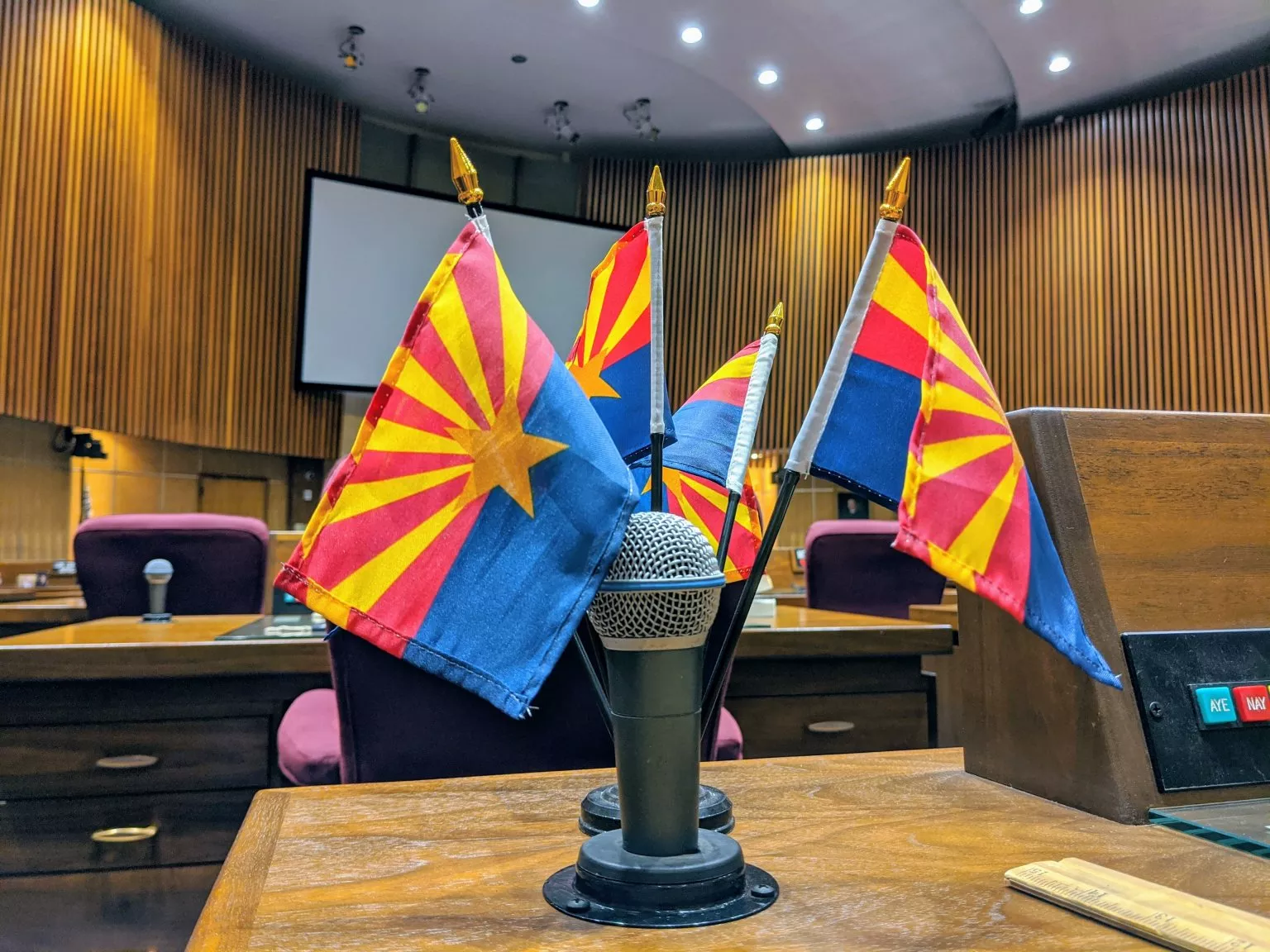
Bans on face mask mandates and critical race theory in schools were the highest-profile laws that were thrown out when the Arizona Supreme Court tossed numerous provisions of the state budget for violating the Arizona Constitution, but the list of new laws that are now off the books is far more extensive than that.
Many of the other rejected laws besides the prohibition on face mask mandates in K-12 schools pertain to the COVID-19 pandemic. Those laws included prohibitions on colleges and universities requiring students to wear masks, get vaccines or submit to regular testing; barring K-12 schools from requiring students to take vaccines that have received emergency approval from the U.S. Food and Drug Administration; and barring cities and counties from requiring “vaccine passports” or otherwise imposing pandemic-related restrictions on private businesses, schools and churches.
Another of the now-defunct laws would have severely curtailed future governors’ ability to use emergency powers to manage health emergencies such as the coronavirus outbreak. Starting in 2023, when Gov. Doug Ducey will leave office, governors would have been limited to 30-day emergency proclamations for public health emergencies, with the option to extend it for no more than 120 days — though it could be extended for longer with legislative approval.
Various election laws were also scrapped by the Arizona Supreme Court’s ruling. One provision would have required counties that wanted to include anti-fraud countermeasures in their ballots to use specific kinds of types of paper and specific technologies, such as holographic foil, special inks and watermarks. A $12 million “election integrity fund” that the state treasurer would have administered to fund election security measures at the county level is also now gone.
Also gone is the creation of a “major events fund” that would have helped the state shoulder the cost of hosting the 2023 Super Bowl, as well as attract sporting and other events in the future.
Thursday, November 4, 2021
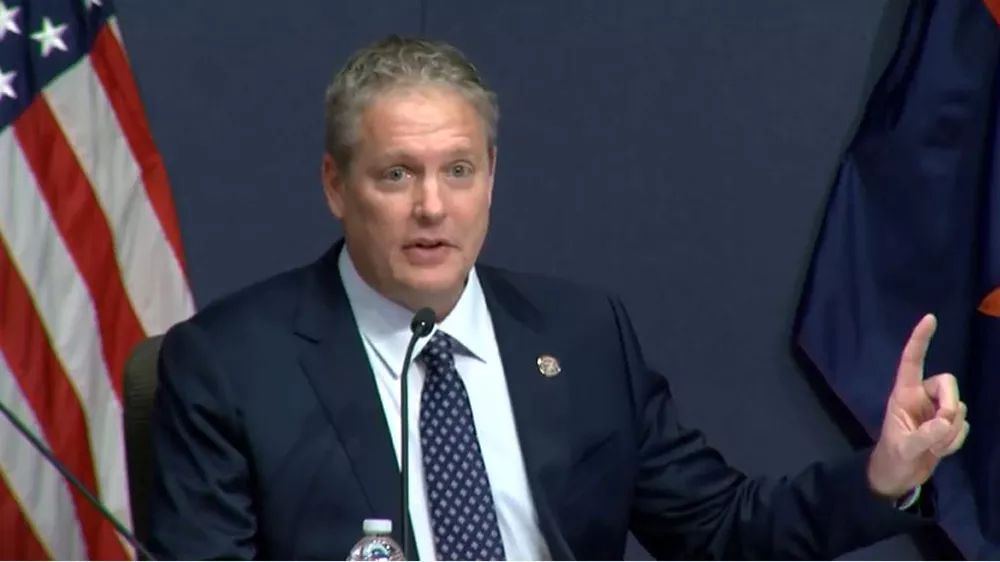
WASHINGTON – It’s been a year since the 2020 elections, but Maricopa County Supervisor Clint Hickman said he continues to get threats for his part in certifying the election.
“We’ve been at this for a year, and it’s difficult,” Hickman said Tuesday during a Washington Post Live forum on the aftermath of the Jan. 6 riots.
Hickman said the anger began election night and escalated after Jan. 6, when he arrived home to find police guarding his house. Besides the personal impact, he said the abuse is beginning to take its toll on election workers who are quitting because they “don’t want to take the abuse, and they want to stand down.”
“That’s the problem I’m seeing with public service,” Hickman said. “We are losing competent election workers across the United States because they just can’t take the threats.”
That reaction is not surprising, said Keith Allred, executive director for the National Institute for Civil Discourse at the University of Arizona.
“Most people aren’t going to want to deal with death threats when they’re just doing their job,” Allred said. “When it turns to not only being ugly speech, but threats of violence and actual violence, what reasonable person isn’t going to consider that? It’s going to make it harder for good people to think about public service.”
Allred said threats like those leveled at Hickman and other county and state officials have never been an effective way to spread a message or change minds, and never will.
“You’re going to hurt your own cause and your own message by threatening violence. That never has worked in a republic, it can’t ever work,” he said.

Wednesday, November 3, 2021
A number of incumbent lawmakers find themselves facing suddenly unfavorable electoral prospects under the proposed legislative map drawn by the Arizona Independent Redistricting Commission.
Some lawmakers who were previously in politically advantageous districts may now have to run in districts controlled by the other political party. Others remain in friendly territory from a partisan standpoint, but face potentially tough primary elections after getting lumped in with other incumbents who had previously been in different districts.
The district lines will change before they become final, giving a potential lifeline to legislators who hope to get better districts than the ones they got when the commission approved its official draft maps on Thursday. The AIRC on Nov. 6 will begin a 30-day public comment period to receive input on the maps. After that, the commissioners can revise the district boundaries before giving final approval to the congressional and legislative maps that Arizona will use for the next decade, a process they hope to complete by late December.
For a number of lawmakers, the draft map moved them into districts that strongly favor the other party.
The draft map moves Sen. Wendy Rogers, R-Flagstaff, from a conservative district that has never elected a Democrat into solidly blue District 6, which was drawn to ensure that Native American voters in northern Arizona, who heavily favor Democrats, can elect the candidates of their choice. Rogers’ home is about a half-mile from the nearest border of strongly conservative District 7, which includes most of the area she currently represents, leaving open the possibility that she could end up in a different district when the final lines are drawn. Some political insiders question whether she might move if that doesn’t happen.
Sen. Tyler Pace, a Mesa Republican, now finds himself in a marginally competitive but Democratic-leaning district. His home is less than two miles from the boundary of a staunchly conservative district that covers much of east Mesa.