Tuesday, June 8, 2021
PHOENIX — Mo
[image-1]st youth who have played basketball at the park or in their driveway have likely done this: pretended to hit a high-stakes shot as the buzzer sounds. That could happen more often during Arizona high school basketball games if the state moves forward with a 35-second shot clock.
The National Federation of State High School Associations announced a new shot clock adoption option in May after eight states, including California, Washington state, and New York, completed an entire season testing the clock. Data and information gathered from these states through surveys were provided to the NFHS, which led to its decision. The adoption option allows state high school associations to choose whether they want to implement a shot clock as early as the 2022-2023 season.
Karrisa Niehoff, executive director of the NFHS, said the initial vote by the rules committee was 11 to 1 to allow the adoption option.
NFHS rules, historically, forbid states from using shot clocks at the high school level, and if schools did, state associations forfeit their seat on the rules committee. Now, state associations will remain on the committee regardless of what option they decide.
Since Arizona was not one of the eight states previously testing a shot clock, the Arizona Interscholastic Association plans to build from preliminary data, and do a thorough gathering of data in the next year which will be used to decide whether to add the clock as early as the 2022-2023 season.
Joe Paddock, assistant director of the AIA, said the association will look to its schools, athletic directors and coaches for insight.
“If the schools are in favor of it, you know, certainly we’re going to support our schools as we do and we’ll get the shot clock implemented,” Paddock said.
With help from Monarch Sports Arizona, a sports events-management company in Phoenix, the AIA started preliminary research on implementing a shot clock in the Visit Mesa Challenge during the 2018-19 season. The four-day event held at Mesa Mountain View High School featured 16 schools, a few from out of state and local schools like Sunnyslope, Chaparral, Rancho Solano and Corona del Sol.
TEMPE – Candidates are lining up to become Arizona’s next governor in 2022, when Republican Doug Ducey terms out under state law.
Last week, two prominent women joined the race: Secretary of State Katie Hobbs, who has gained national prominence defending the state’s 2020 election, wants to be the Democratic candidate, and former news anchor Kari Lake, who resigned from Fox 10 in March, wants to represent the Republican Party.
They joined Republican hopefuls Kimberly Yee and Karrin Taylor Robson, and Democrat Marco Lopez.
Although Republicans are running on former President Donald Trump’s policies, Hobbs is addressing unfounded allegations of fraud in the 2020 presidential election repeatedly pushed by Trump and many state Republicans. Hobbs has denounced the so-called audit organized by Arizona state senators to review the 2020 presidential election ballots, and told CNN she thinks “this whole thing is a joke.”
“In 2020, against all odds, in the middle of a pandemic, we proved that democracy works,” Hobbs said in a video announcing her campaign. “It’s been my job and life’s work to make government work for the people of Arizona. That’s why I’m running.”
Among gubernatorial candidates, Hobbs was at the top of the power rankings by OH Predictive Insights, a market research firm in Phoenix, even before officially announcing her candidacy. The rankings are based on an online survey of 935 registered Arizona voters conducted the first week of May. Respondents were asked to rate 40 notable Arizonans, regardless of whether any of them actually intend to seek office.
In her campaign announcement, Hobbs noted her efforts to expand Medicaid for seniors and implement the Arizona Opioid Epidemic Act in 2018, which offered increased access to treatment and opioid overdose countermeasures, such as Naloxone.
As governor, Hobbs promised she would protect survivors of abuse, rebuild the post-COVID-19 economy, invest in health care and education and “ensure that your race, gender or ZIP code does not dictate your destiny.”
Monday, June 7, 2021
A long-simmering neighborhood feud turned deadly in the Catalina area on Friday, June 4, leading to two deaths, including the shooter, according to the Pima County Sheriff’s Department.
Jose Carlos Valdez, 60, was shot and killed, and deputies later found the apparent shooter, Benjamin Jacinto, 72, dead of self-inflicted gunshot wounds.
The Pima County Sheriff’s Office offered the following details:
Deputies responded to a 911 call from a woman who said her children had been shot by a neighbor near the intersection of Coronado Sunset Drive and Coronado View Road.
On their way to the scene, deputies were flagged down and stopped to render aid to two adult male shooting victims before paramedics from the Golder Ranch Fire Department arrived on the scene. The men were transported to a hospital and treated for non-life-threatening injuries.
When deputies arrived at the residence where the shooting took place, they learned that a third shooting victim might be inside. They entered the house and discovered Jacinto. As they spoke with him, they learned he matched the description of the shooter. Jacinto then ducked behind a wall and fired multiple gunshots.
Deputies retreated from the home to create a containment perimeter. While they were securing the area, they discovered the body of Valdez, who had been shot dead.
SWAT team members, along with a bomb squad, send a robot into the home to search for Jacinto. The robot’s footage showed that Jacinto was dead of an evident self-inflicted gunshot wound.
A subsequent investigation revealed the neighbors had been engaged in a long-running feud.

WASHINGTON – With less than four weeks remaining in this fiscal year, local governments in Arizona are anxiously watching state budget negotiations that they fear could end up delivering a “huge hit” to city and town finances.
At issue in the stalled budget negotiations is a proposal to lower the state income tax to an across-the-board 2.5%, which would result in about a $1.5 billion reduction in tax revenues next year – revenues that local governments get a share of and are heavily reliant on.
“Under the current proposal, we’re projecting we would lose approximately $27 million a year in state shared income tax revenue,” said Nathaniel Sigal, senior policy adviser for Tucson Mayor Regina Romero. With the city getting about $80 million a year from the income tax, a 2.5% flat tax “would constitute about more than a third of our state income tax revenues just vanishing.”
But supporters of the flat tax point to a projected $1 billion state surplus, the result of tax collections that have been sharply higher than expected and billions in federal COVID-19 stimulus funding. An aide to Gov. Doug Ducey said it is hard to argue against an income tax cut when “the state is flush with resources” and the “economy is booming.”
“We’ve really broadened the base where we have a lot more revenue streams coming in at all levels, local all the way up to the state,” Ducey Chief of Staff Daniel Scarpinato said in a May 30 interview with Fox 10. “Just in terms of the income tax reductions, for the average Arizona taxpayer, it’s a 13% reduction in what they pay; that’s $350 back in their pocket every year.”
Scarpinato dismissed local government fears as “ridiculous,” saying cities and towns are sharing in the surging revenues.
But one local government representative said there is still no getting around the fact that “any significant income tax cut would have an impact on local governments here in Arizona.”
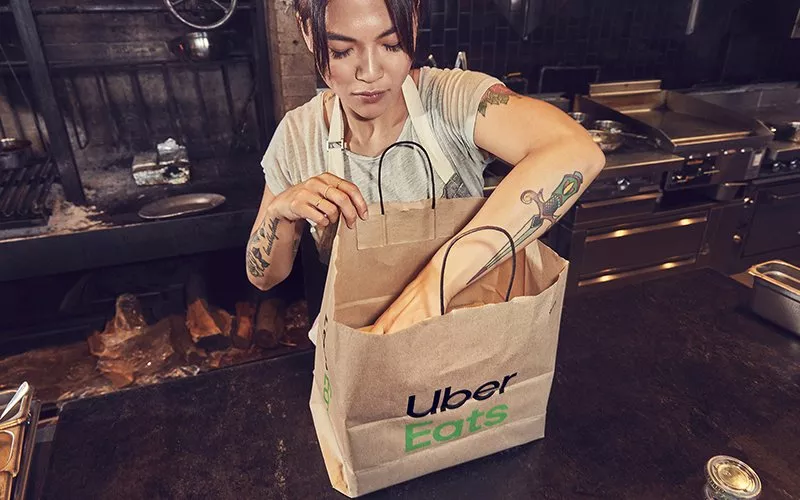
WASHINGTON – Uber Eats, Postmates and DoorDash said they will no longer waive delivery fees for customers who order from Black-owned restaurants in Arizona, to settle charges by the state that the deals violated the Arizona Civil Rights Act.
The agreement, announced Wednesday, settles a claim by the Arizona Attorney General’s Office that waiving fees just for Black-owned businesses “unlawfully discriminated against non-Black owned restaurants and their patrons.”
The companies “adamantly deny any wrongdoing” in the promotions, which were announced last summer at the height of the Black Lives Matter movement. The deals ended in December, as scheduled, but the companies said they will continue working to support Black businesses through such efforts as identifying Black-owned restaurants in a separate category on the apps.
“We’re proud to have supported Black-owned businesses and we’ll continue to make it a priority,” an Uber spokesperson said Wednesday. “We have heard loud and clear from consumers that the ability to easily identify Black-owned restaurants on Uber Eats is a feature they want and appreciate.”
The Attorney General’s Civil Rights Division notified Uber, Postmates and DoorDash in November that the promotions violated the civil rights law’s public accommodations section, which prohibits discrimination based on a person’s “race, color, religion, sex, national origin or ancestry.”
Attorney General Mark Brnovich did not respond to a request for comment Wednesday, but in a prepared statement he said his office took the action “to protect civil rights and ensure businesses offer their services and products based on equal and neutral criteria.”
Sunday, June 6, 2021
Saturday, June 5, 2021