

Monday, April 26, 2021

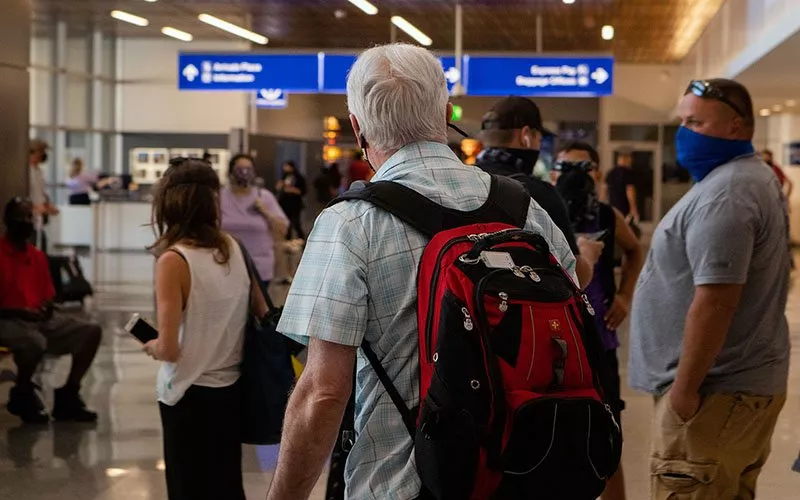
WASHINGTON – With vaccination efforts in full force, airlines and airports are on their way to bouncing back from a year in which passenger traffic fell as much as 96% because of the pandemic, officials told a Senate panel Wednesday.
And that improvement has also been seen at Phoenix Sky Harbor International Airport, where “we were very, very excited to see numbers increase to about 70%” of pre-pandemic levels, said Charlene Reynolds, assistant aviation director of the Phoenix Department of Aviation.
“Here at Sky Harbor, we are currently seeing some revival of traffic,” Reynolds said in her testimony to the Senate Commerce subcommittee. “We looked at some of the projections from the rating agencies, they believe we will return to normalcy in 2024, however, we’re very hopeful that passengers will return sooner than 2024.”
While they talked about gains, however, much of the hearing was dedicated to the question of health concerns associated with increased travel, and the need to keep enforcing COVID-19 safeguards.
“I look forward to hearing from our witnesses about how safe it is to fly, and what the future holds for air travel,” said Sen. Roger Wicker, R-Miss., who said recent guidance from the Centers for Disease Control and Prevention does not provide the clarity “needed to maintain public confidence.”
Sunday, April 25, 2021

Saturday, April 24, 2021

Friday, April 23, 2021
The Pima County Health Department has pivoted in the direction of “Plan B” after plans for a federal POD died before implementation.
At the Tuesday Board of Supervisors meeting, County Administrator Chuck Huckelberry announced the Arizona Department of Emergency Management Division had informed them that the State Department of Health and the Federal Emergency Management Agency could not agree on the terms for the federal POD in Pima County.
“Team, after much consideration, and our best efforts, we were unable to find a fair and workable solution related to the FEMA-State agreement," Director of Emergency Management Allen Clark wrote in an email that Huckelberry shared with the board. "Therefore, DEMA, on behalf of the state will not sign the agreement.”
The original FEMA offer, made in March, would have brought enough vaccine to Pima County outside of the state's normal allocation for a six-week clinic that could have vaccinated an estimated 210,000 residents in low-income and minority neighborhoods, as those groups have lagged behind affluent white people in vaccination rates.
The federal POD, which required state approval, was originally denied by Governor Doug Ducey in March. On March 26, Dr. Cara Christ announced they would allow the county to move forward, so long as the site is independent of the state.
The agreement proposed by the state and released by the county on April 13 made clear the state would not be responsible or provide any assistance or resources for the federal POD. They also requested the county use its own registration system different from the state’s system. In the April 13 memo, Huckelberry said some of the terms and conditions appeared “particularly draconian.”
From March until now the vaccination effort has slowed, with the county and the state working on vaccinating individuals who may not have ready access to a vaccine or are vaccine hesitant, as well as dealing with the pause of the Johnson & Johnson vaccine.
Pima County Medical Director Dr. Francisco Garcia said there is much more vaccine available now than there was when state officials were rejecting the deal, so it amounted to a lost opportunity, but the county had other ways to partner with FEMA.
“At the time that we made our ask and if in the timeframe that we would have gotten that resource it would have been terrific," Garcia said. "But given that the state and FEMA could not come to an agreement on the contractual language to allow us to pull in a large federal POD, what we have done is we have pivoted to our Plan B.”

With 896 new cases reported today, the total number of Arizona’s confirmed novel coronavirus cases rose past 857,000 as of Friday, April 23, according to the Arizona Department of Health Services.

Pima County, which reported 96 new cases today, has seen 114,721 of the state’s 857,347 confirmed cases.
With 17 new deaths reported this morning, a total of 17,238 Arizonans have died after contracting COVID-19, including 2,389 deaths in Pima County, according to the April 23 report.
A total of 594 coronavirus patients were in the hospital as of April 22. That’s roughly 11.5% of the number hospitalized at the peak of the winter surge, which reached 5,082 on Jan. 12. The summer peak was 3,517, which was set on July 13, 2020. The subsequent lowest number of hospitalized COVID patients was 468, set on Sept. 27, 2020.
A total of 995 people visited emergency rooms with COVID-like symptoms on April 22. That number represents 42.5% of the record high of 2,341 set on Tuesday, Dec. 29, 2020. That number had peaked during the summer wave at 2,008 on July 7, 2020; it hit a subsequent low of 653 on Sept. 28, 2020.

A suspect in a fatal shooting on Tucson's East Side was arrested Thursday in Buckeye.
Buckeye Police received a tip that a suspect in the Thursday morning shooting was at Loves Truck Stop at Miller Road and Interstate 10. He was located and arrested, police said.
Officials have not released any more information.
Two of the leading Republican firebrands in Congress touted big fundraising hauls as a show of grassroots support for their high-profile stands against accepting the 2020 election results.
But new financial disclosures show that Sen. Josh Hawley, R-Mo., and Rep. Marjorie Taylor Greene, R-Ga., relied on an email marketing vendor that takes as much as 80 cents on the dollar. That means their headline-grabbing numbers were more the product of expensively soliciting hardcore Republicans than an organic groundswell of far-reaching support.
Hawley and Greene each reported raising more than $3 million in the first three months of the year, an unusually large sum for freshman lawmakers, according to new filings with the Federal Election Commission. That’s more than the average House member raises in an entire two-year cycle, according to data compiled by the Center for Responsive Politics. The tallies generated favorable press coverage for Hawley and Greene, and they both seized on the numbers to claim a popular mandate.
Politico called Greene’s result “eye-popping” and “staggering,” a sign that she “appears to have actually benefited from all the controversies that have consumed her first few months in office.” The House voted in February to remove Greene from her committee assignments because of her social media posts that promoted far-right conspiracy theories; racist, anti-Semitic and anti-Muslim rhetoric; and violence against Democratic leaders.
“I am humbled, overjoyed and so excited to announce what happened over the past few months as I have been the most attacked freshman member of Congress in history,” Greene said in an emailed statement on April 7. “Accumulating $3.2 million with small-dollar donations is the absolute BEST support I could possibly ask for!”
As for Hawley, who was the first senator to say he’d object to certifying the Electoral College results on Jan. 6, Politico proclaimed that his massive increase showed “how anti-establishment Republicans are parlaying controversy into small-dollar fundraising success.” Hawley’s pollster, Wes Anderson with the political consulting firm OnMessage, said in a memo distributed to supporters that the “fundraising surge” made “crystal clear that a strong majority of Missouri voters and donors stand firmly with Senator Hawley, in spite of the continued false attacks coming from the radical left.”
It wasn’t until later, when the campaigns disclosed their spending details in last week’s FEC reports, that it became clearer how they raised so much money: by paying to borrow another organization’s mailing list.
“List rental” was the No. 1 expense for both campaigns, totaling almost $600,000 for each of them. It’s common for campaigns to rent lists from outside groups or other candidates to broaden their reach. But for Hawley and Greene, the cost was unusually high, amounting to almost 20% of all the money they raised in January, February and March.

