
Wednesday, January 6, 2021
PAONIA, Colorado – A.J. Carrillo farms 18 acres near Hotchkiss, Colorado, in the high desert of the Western Slope about an hour southeast of Grand Junction. When he irrigates his peach orchard, water gushes from big white plastic pipes at the top of the plot and takes half a day to trickle down to the other end of his 5-acre orchard.
Carrillo is planning to convert his Deer Tree Farm from flood irrigation, which has been commonly used in the West for more than a century, to a new and much more efficient style of irrigation – microsprinklers.
Changing irrigation methods is something more and more Western Slope agricultural producers, from small to large, are doing. With help from federal funding, they’re able to apply less water to grow their crops and make their land more resilient to drought. And more important, the switch also means that fewer pollutants run off their fields into the Colorado River, keeping it cleaner all the way down to Mexico.
Salt and selenium occur naturally in the shaley soils of the Gunnison Basin, leftovers of a prehistoric inland sea. Both substances are harmful to plants, fish and humans. Flood irrigation of fields allows water to penetrate deep into the soil, where it dissolves out salt and selenium. The contaminated water then runs off into ditches that eventually empty into the Gunnison River, and from there into the Colorado. The result is that farms in the Gunnison Basin send more than 360,000 tons of salt into the Colorado River each year.
“So we have a serious ecological issue going on here,” Carrillo said.

Tuesday, January 5, 2021

The bookstore was founded by Syrena Arevalo-Trujillo, a University of Arizona alum who noticed a lack of representation for children of color in literature while teaching at a local charter school.
Arevalo-Trujillo was looking to open a bookstore at the same time Hotel McCoy, 720 W. Silverlake Road, was developing a “community support program for entrepreneurs who were seeking opportunities to start a storefront business.”
Barrio Books dedicates 15% of their shelf space to Indigenous authors and authors of color. They carry new and used books, including local authors, and have a book trade-in program. Hotel McCoy guests will receive 10% off Barrio Books purchases.
Hotel McCoy, which opened in 2018, showcases Tucson’s art and culture by having local artists design the hotel’s rooms and lobbies. In addition, they offer local food, beer and more.
For more information, visit barriobooks520.com and hotelmccoy.com
PHOENIX – Arizona State swim coach Bob Bowman has faced many challenges throughout a nearly 35-year-long coaching career, a portion of it guiding Michael Phelps, the most decorated Olympian.
However, Bowman never had to navigate the postponement of the Olympic Games and all of the potential ramifications of the delay.
Welcome to sports in the COVID-19 era.
When the International Olympic Committee announced in March that it was postponing the 2020 Tokyo Olympic Games, which were to take place July 24-Aug.9, because of the global pandemic, it left Olympic hopefuls and their coaches searching for the best ways to proceed with training.
The Games are now scheduled to unfold from July 23-Aug. 8, 2021.
Olympians face enough challenges while training to arrive at the Summer Games in top form, even without the added obstacle of a postponement. There is little precedent for them to know how to prepare for an event they have worked toward for four years when their plan is suddenly pushed forward a year and at a time when people are discouraged from gathering.


In two weeks, the Pima County Board of Supervisors will discuss renewing County Administrator Chuck Huckelberry’s contract and whether or not they will grant him the $13,000 raise he’s asked for.
The board was slated to vote on the top administrator’s contract at its first meeting of the year this morning, but voted to delay the discussion to a private executive meeting in two weeks.
Serving as county administrator since 1993, Huckelberry oversees more than 7,300 employees and operates under the direction of the Pima County Board of Supervisors.
Huckelberry’s current contract, renewed in January 2017, entitles him to an annual base salary of $302,000. Now, Huckelberry’s asking for a salary of $315,000 per year and four more years as county administrator.
If approved, the 4.3% raise and Huckelberry’s position would remain in effect until Jan. 7, 2025. For the next two weeks, he remains county supervisor through an extension of his contract approved in 2017.
Today, three new officials attended the meeting for their first time as newly elected supervisors, including Rex Scott of District 1, Matt Heinz of District 2 and Adelita Grijalva of District 5. The three are replacing former supervisors Ally Miller, Ramón Valadez and Betty Villegas.
Grijalva posed the motion to table the contract’s discussion for two weeks. The supervisors approved the motion in a 3-2 vote, with supervisors Steve Christy and Matt Heinz opposing.
At the meeting, Christy proposed a motion to not renew Huckelberry’s contract at all, while Heinz proposed extending the contract for 12 months with no pay raise. Both motions failed.
Christy expressed concern about discussing the county administrator’s contract privately, and said, “It should be discussed in front of the public at the board meeting and not behind closed doors.”
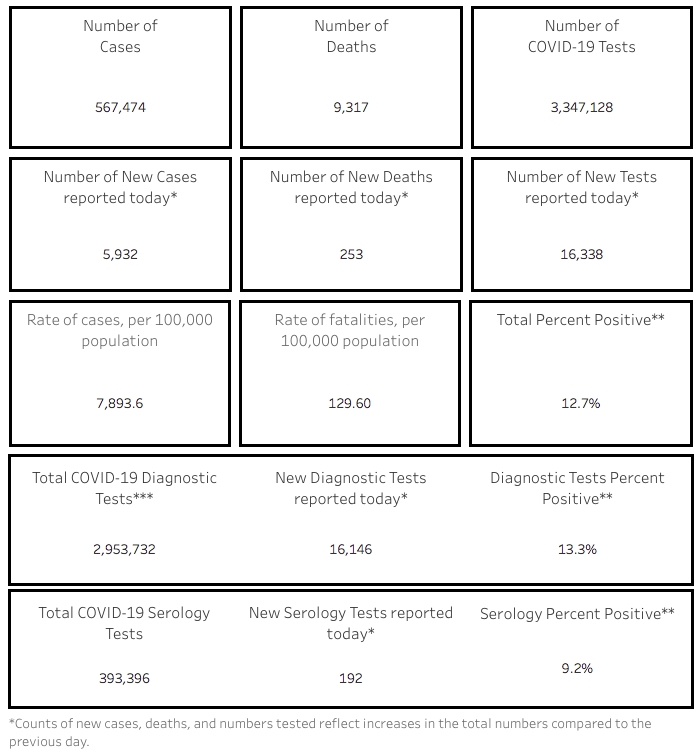
With more than 5,900 new cases reported today, the number of Arizona’s confirmed novel coronavirus cases topped 567,000 as of Tuesday, Jan 5, according to the Arizona Department of Health Services.

Pima County, which reported 621 new cases today, has seen 75,584 of the state’s 567,474 confirmed cases.
A total of 9,317 Arizonans have died after contracting COVID-19, including 1,137 deaths in Pima County, according to the Jan. 5 report.
The number of hospitalized COVID cases statewide continues to soar as the virus has begun to spread more rapidly, putting stress on Arizona’s hospitals and surpassing July peaks. ADHS reported that as of Jan. 4, a record 4,789 COVID patients were hospitalized in the state. The summer peak of 3,517 hospitalized COVID patients was set on July 13; that number hit a subsequent low of 468 on Sept. 27.
A total of 1,984 people visited emergency rooms on Jan 4 with COVID symptoms, down from the record high of 2,341 set on Tuesday, Dec. 29. That number had previously peaked at 2,008 on July 7; it hit a subsequent low of 653 on Sept. 28.
A record number of 1,096 COVID-19 patients were in intensive care unit beds on Jan. 4. The summer’s record number of patients in ICU beds was 970, set on July 13. The subsequent low was 114 on Sept. 22.
A website that tracks COVID infections across the globe reports that Arizona now has highest rate of COVID infection in the world.
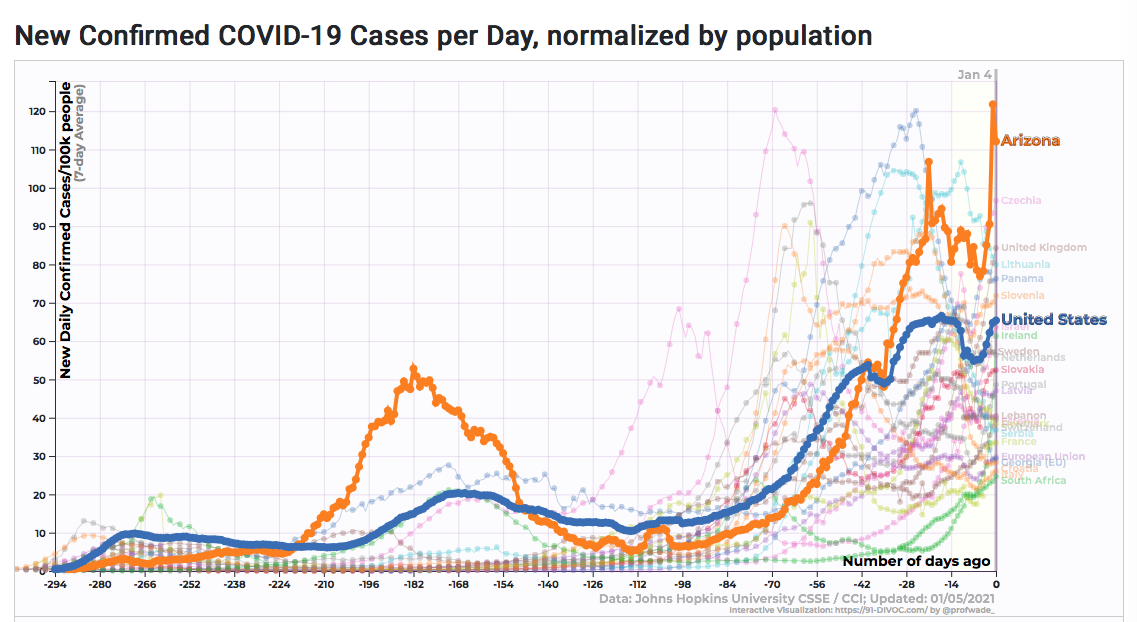
As reported yesterday by ABC-15’s Garrett Archer, the website 91-divoc.com, which uses data from Johns Hopkins University, reports that Arizona is seeing 121.8 infections per 100,000 people on a seven-day average, compared to 64.5 infections per 100,000 for the United States as a whole.
The Pima County Health Department reported that in the first four days of 2021, Pima County hospitals reported 70 COVID deaths. Other Pima County Health Department stats from Jan. 4:
WASHINGTON – Post-9/11 veterans are not only more likely to be employed than the general population, they are also more likely to be in jobs that are immune to recession, according to a recent report by the Census Bureau.
The Census study, released in November, said the unemployment rate for the nation’s 3 million post-9/11 veterans was just 4.8% between 2014 and 2018, compared to 5.0% for nonveterans during the same period. The veterans were also more likely to be working full-time, year-round jobs, putting in more hours and earning more.
The most popular job for post-9/11 veterans was in protective services, such as police and fire departments, where vets were three times as likely as nonveterans to be working. A Phoenix Police Department spokeswoman said, for example, that 20% of the department’s sworn officers have military experience.
Other common jobs for the post-9/11 veterans were in installation, maintenance and repair fields, transportation, and computer and mathematical fields, the report said.
“It doesn’t surprise me to hear that veterans are leveraging the things that they learned in the military, adding education to that, and doing very well in the job world,” said Christian Rauschenbach, assistant director of veteran services and operations for the Pat Tillman Veterans Center at Arizona State University.

Monday, January 4, 2021

After 25 years of serving specialty Greek dishes with a casual style, Fronimo's on Speedway is closing their doors. Thanks to shifting their business to take-out only, Fronimo's was able to survive nearly a year of pandemic difficulties. Ultimately, owners George and Tracy Fronimakis cited their landlord "astronomically" raising their rent as the reason for their closure.
"We have truly given our love to this business for 25 years now, raising our daughter (and now our granddaughter) in this restaurant, and we have greatly enjoyed getting to know our wonderful customers and your families over all these years," Tracy and George wrote in their closure announcement. "We want to thank all of you for supporting our family business for so long; we definitely could not have done it without you."
The Fronimakis family is currently searching for another location to move their restaurant, but acknowledge the pandemic has limited their ability to find a new space and move. Should they find a suitable location, they hope to re-hire their same employees — some of whom have worked at Fronimo's for more than a decade.
Fronimo's won Best Greek Food in our annual Best of Tucson poll multiple times over the years, and served as a meeting place for several local organizations.
"We will keep you updated on our website and Facebook pages; please check in with us from time to time," Tracy and George wrote. "Until we meet again."