

Monday, January 4, 2021

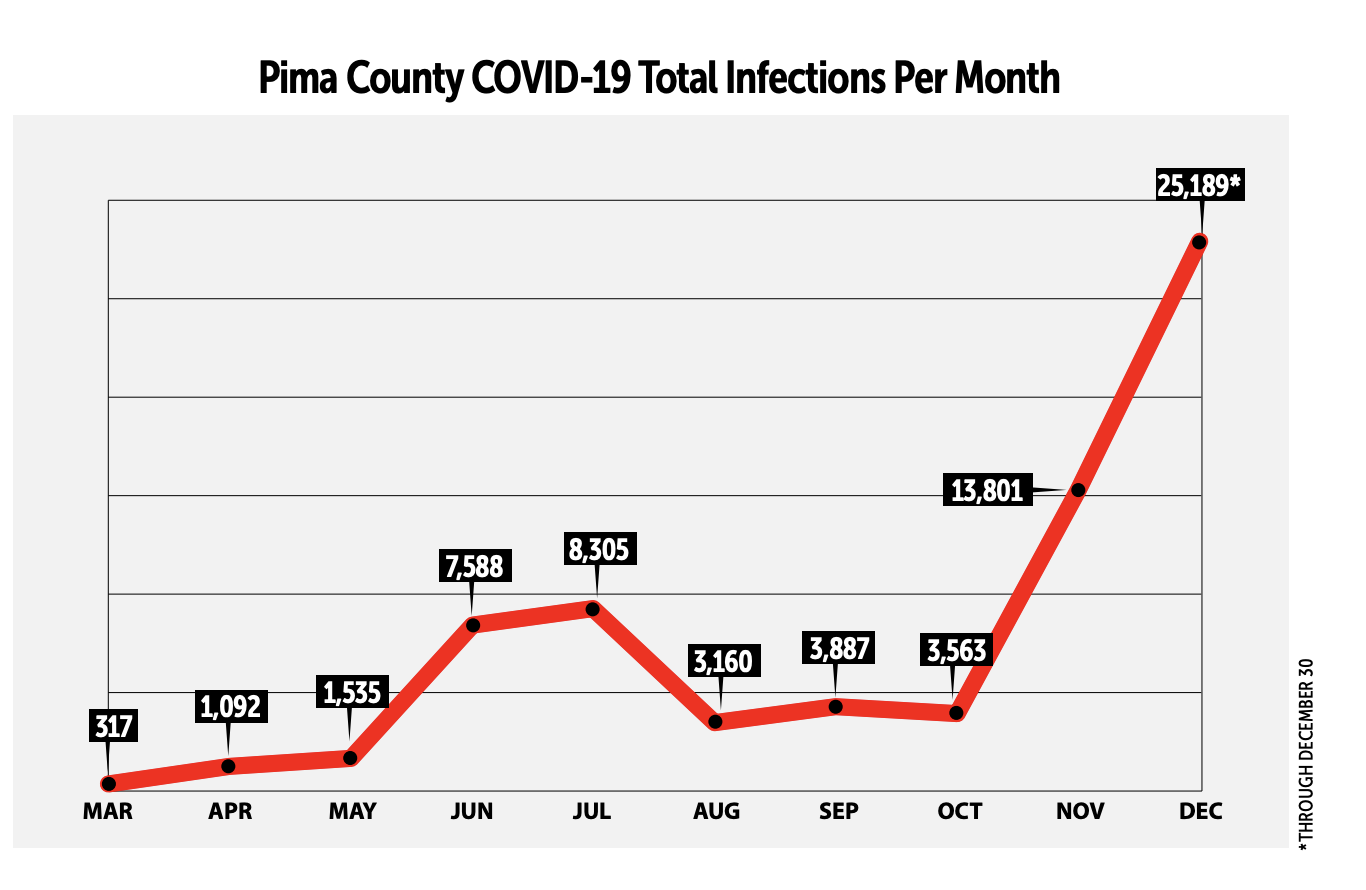
In Pima County, the entire month of December saw nearly 40% of the total number of COVID-19 cases reported since the beginning of the pandemic, according to a memorandum from County Administrator Chuck Huckelberry.
Furthermore, a new public health advisory issued by the county’s health department revealed one out of every 1,000 Pima County residents has died from COVID-19.
With large gatherings over the holidays, experts expect case counts and coronavirus deaths to increase with “no plateau yet in the immediate horizon,” the administrator’s memo says.
As of Dec. 30, Pima County had only 5 ICU beds available. Bed usage hit a record of 370 ICU beds occupied, with 53% of them holding COVID-19 patients. There were 42 medical surge beds available, according to the county administrator’s memo.
Meanwhile, 87 patients waited in emergency departments to receive care in inpatient beds—more than 60% of them with COVID-19.
Setting a new record for the county, 145 ventilators were in use by coronavirus patients out of 250 in use overall.
In a Facebook post on Dec. 31, the Pima County Health Department reported that for the entire month of December, there was an average of 11 COVID-19 deaths per day.
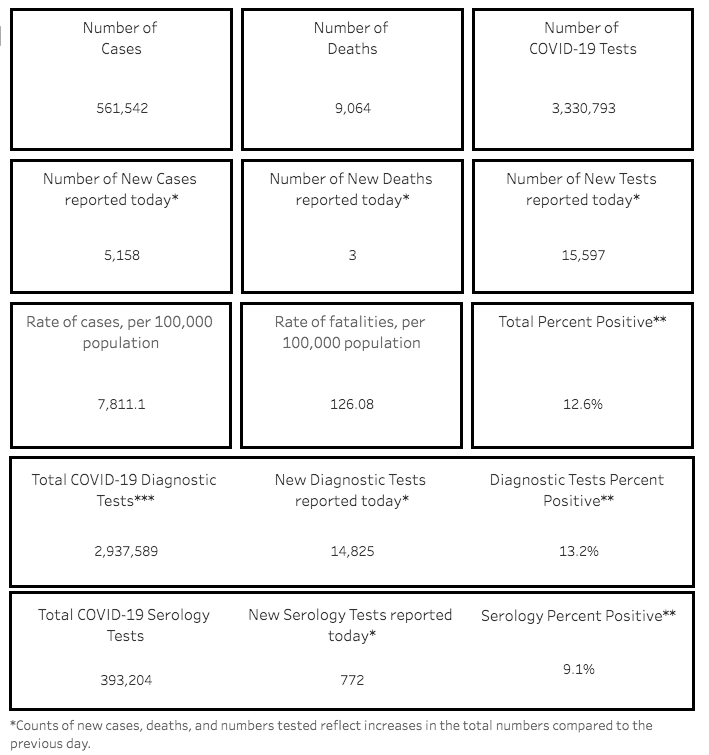
With more than 5,100 new cases reported today, the number of Arizona’s confirmed novel coronavirus cases topped 561,000 as of Monday, Jan 4, according to the Arizona Department of Health Services.

Pima County, which reported 855 new cases today, has seen 74,963 of the state’s 561,542 confirmed cases.
A total of 9,064 Arizonans have died after contracting COVID-19, including 1,084 deaths in Pima County, according to the Jan. 4 report.
The number of hospitalized COVID cases statewide continues to soar as the virus has begun to spread more rapidly, putting stress on Arizona’s hospitals and surpassing July peaks. ADHS reported that as of Jan. 3, a record 4,647 COVID patients were hospitalized in the state. The summer peak of 3,517 hospitalized COVID patients was set on July 13; that number hit a subsequent low of 468 on Sept. 27.
A total of 2,001 people visited emergency rooms on Jan 3 with COVID symptoms, down from the record high of 2,341 set last Tuesday, Dec. 29. That number had previously peaked at 2,008 on July 7; it hit a subsequent low of 653 on Sept. 28.
A record number of 1,082 COVID-19 patients were in intensive care unit beds on Jan. 3. The summer’s record number of patients in ICU beds was 970, set on July 13. The subsequent low was 114 on Sept. 22.
The Pima County Health Department reported that in the month of December:
• There was an average of 11 COVID-19 deaths per day.
• There was an average of 130 COVID-19 positive patients admitted per day.
• ICU bed availability averaged 3%. Medical/surgical bed availability averaged 4%
• There was an average of 545 COVID-19 positive inpatients at county hospitals each day.
• An average 154 ICU beds were used by COVID-19 patients each day.
• There was an average of 104 ventilators in use for COVID-19 patients per day.
The health department continues to ask residents to stay home and minimize activities that involve contact with people outside of their households, stay physically distanced and practice mask-wearing and frequent sanitization.
“This isn’t just about COVID anymore and whether you think it’s a real problem or not. The patients filling these hospitals are absolutely real and if you have a heart attack, or if you get into a car accident, or your appendix bursts, there is a real possibility that you may not get the timely care you need to save your life if we don’t get control of this virus,” said Dr. Theresa Cullen, director of the Pima County Health Department. “People are dying yet many of those deaths are preventable if the people of this community stay home, wear their masks and avoid people they don’t live with as much as possible.”
WASHINGTON – For years, Democrats have argued that Arizona was about to turn blue, and this year they came closer than they had in decades, winning the presidential race and unseating an incumbent Republican senator.
Close, but not the “blue wave” Democrats had been hoping for.
While they grabbed the top two races on the ballot, Democrats made little to no headway in state, local or other congressional races.
“This year’s election does not signify a blue wave because Democrats didn’t win up and down the ballot in Arizona,” said Kim Fridkin, foundation professor of political science at Arizona State University.
Or, as Republican political consultant Jason Rose put it, the blue wave was more of “a wave that you might see at the bay, not the ocean.”
Still, Democrats see progress in the two big wins they did get. Yara Marin, the Arizona state political director for Mi Familia Vota, said even though “the blue wave didn’t trickle down the ballot, I want to really … state that this still is a historic moment.”
That historic moment was highlighted last month when Democratic Sen. Mark Kelly was sworn in to the seat that had been held by Republican Sen. Martha McSally and, before her, by Sen. John McCain, a Republican icon. Kelly joins Sen. Kyrsten Sinema to give the state two Democratic senators for the first time in almost 70 years.

Friday, January 1, 2021
WASHINGTON – Hate crimes in Arizona bounced back in 2019 after a sharp drop the year before, and advocates say they fear the numbers are only going to continue to rise when the tumult of 2020 is reported.
Despite a steep increase from the 173 hate crimes recorded in Arizona in 2018, the state’s 217 hate crimes in 2019 were just below average for the past decade, according to data from the FBI’s Uniform Crime Report.
But advocates note that the latest FBI numbers do not include events from 2020, including Black Lives Matter protests and the COVID-19 pandemic, which led to reports of anti-Asian violence for what President Donald Trump repeatedly called the “Wuhan virus.” These numbers are likely to surge again when 2020 results are reported next year, they said.
“We have seen a surge in hate crimes and hate incidents against Asian Americans in connection with COVID-19, our community is being wrongly blamed,” said Marita Etcubañez, director of strategic initiatives for Asian Americans Advancing Justice. “The numbers we just got (from the FBI) are for 2019, so none of the COVID-19 data will have been captured in the numbers just released.”
And none of the Black Lives Matter protests that followed the police killing of George Floyd in Minneapolis are captured in the 2019 numbers either, said Lecia Brooks, chief of staff at the Southern Poverty Law Center.

Thursday, December 31, 2020
The Internal Revenue Service and the U.S. Treasury Department announced the second round of Economic Impact Payments are in the process of being distributed to millions of Americans who received a first round of payments last spring.
Individuals are eligible for $600 and married couples who file a joint return will receive $1,200. In addition, citizens could receive an extra $600 for each qualifying child. Dependents over the age of 17 are not eligible for the child payment. Individuals who filed an adjusted gross income of more than $75,000 or married couples who made more than $150,000 in 2019 are ineligible for the payment.
In most cases, funds should begin arriving either through direct deposit, paper check, or a debit card by early January. The IRS began mailing paper checks on Wednesday, Dec. 30 and direct deposits have already arrived for some Americans.
Those who did not receive the first round of payments earlier in the year will still be able to claim it on their upcoming 2020 taxes. IRS representatives recommend taxpayers to review the eligibility criteria to make sure they maximize their benefits. Economic Impact Payments will be referred to as Recovery Rebate Credit on Form 1040 or Form 1040-SR due to being an advance payment of the RRC.
The second round of Economic Impact Payments is funded through the Relief Supplemental Appropriations Act of 2021, which was approved by lawmakers earlier this week.
To check if your Economic Impact Payment has been processed, check out the Get My Payment tool at IRS.gov.

Tucson Weekly columnist Brian Smith’s article about the late guitarist Doug Hopkins, co-founder of the Tempe rock band Gin Blossoms, is being turned into a feature film. Smith originally wrote the article for the Detroit Metro Times in 2007, before he and his wife Maggie turned it into a screenplay titled "Lost Horizons." The film is now in pre-production and will be produced by Sarah Platt and Mike Tankel. The director and cast have not yet been selected.
"I’ve been wanting to tell this story in a film for many many years, but it finally came to fruition lately with my wife Maggie as writing partner," Smith said. "I knew Doug really well. He was a good friend, the kind who was never not there. I knew the shy, empathic, totally brilliant, cockeyed and writerly side to him. I loved him dearly. As did many people who knew him. He left a long, long shadow. Really, that love for him was the launching point for the script."
Hopkins co-founded Gin Blossoms in 1987. The band rose to fame after the release of their second studio album, 1992’s New Miserable Experience, which eventually went multi-platinum with singles like "Hey Jealousy" and "Found Out About You." Smith’s original Metro Times article detailed Hopkins' songwriting prowess, as well as his alcoholism, interpersonal struggles, and untimely death.
“The alcoholic side of him is there, and it can be brutal, and it is brutal, but there is also the tender, kind, generous, and absolutely witty and brilliant side to the man that needed to be told,” Smith said. “Also, the guy was a genius at whittling down complicated human truths into a three-minute pop song, such sadnesses beneath the surface. So precious few songwriters, before or since, could do that as well as Doug. That’s truth. Yeah, this all makes his story so hard to tell, and also makes it really layered and strangely beautiful.”
Brian and Maggie have collaborated on multiple projects before. Maggie directed a documentary based on Brian’s Tucson Weekly column “Tucson Salvage,” and they have also started a local press, R&R Press.
"Am I excited about the film in pre-production? Absolutely. Maggie and I are really excited because, for one thing, it is really difficult getting a film made," Smith said. "I am also really nervous because Maggie and I really want it to be accurate to Doug’s heart, to capture the essence of the man’s beauty, and tragedy."
The Pima County Department of Environmental Quality hand-delivered an abatement order to a northwest-side apartment complex owner for causing a public health nuisance to the complex’s tenants by shutting off the water supply.
The county ordered GR Partners Casas Adobes to restore potable water service within 24 hours of receiving the notice or PDEQ will do it for them and send the property owner the bill.
Residents of the 204-unit Casas Adobes Apartment Homes, located at 6200 N. Oracle Road, have been without running water and “unable to bathe, flush toilets or maintain hand hygiene since” Saturday, Dec. 26, according to the order.

