

Wednesday, December 9, 2020
PHOENIX – Arizona has some of the least restrictive gun laws in the U.S., one of three countries that consider gun ownership a constitutional right.
Consider this data: Americans own more than 390 million guns – with 120.5 civilian firearms per 100 people, according to a study by the World Population Review.
In February, Arizona ranked seventh for the number of registered guns per state, at 204,000, according to a telephone survey conducted by CBS News and ranked by ThoughtCo. That number is far from complete, however, because Arizona is one of 44 states that do not require registration of firearms.
During the contentious 2020 election, armed protesters outside Maricopa County’s tabulating center put a spotlight on Arizona’s open carry practice, which allows those 18 or older to openly carry firearms in most places.
A prohibited possessor is an exception to the law, defined as someone who is a convicted felon and has not had their rights to own a firearm restored, an undocumented immigrant, anyone who is detained in a correctional or detention facility, has been found to be a danger to themselves or others, or serving probation for a domestic violence felony or felony offense.
Residents can’t openly carry guns into certain places. They cannot be brought within 1,000 feet of K-12 school campuses, Native American reservations, businesses that serve alcohol or polling locations on Election Day, in addition to several other restrictions that can be found here.
A gun permit allows owners to carry a concealed firearm into a business that serves alcohol if there is not a sign prohibiting them and they don’t drink alcohol, according to Arizona Concealed Carry.
Restrictions have been implemented on how a gun can be transported in a car. For residents under 21, it is illegal to carry a concealed firearm within the immediate control of anyone in the vehicle. Firearms must be transported in a case, holster, storage compartment, trunk or glove compartment. If the gun is in a holster, then it can be concealed anywhere in the car.
“Arizona is considerably more permissive than most states when it comes to concealed carry,” said Adam Winkler, a professor at the UCLA School of Law and an expert on gun rights and civil liberties.
Residents who are at least 21 can legally own or purchase a firearm, can carry a gun loaded and concealed without any type of permit in their vehicle and around the state, according to Arizona’s concealed carry law. The measure, which was established in July 2010, also eliminated the need for a permit for those 21 or older to carry a concealed firearm.
That means residents do not have to go through a background check if they buy the weapon from a private seller and do not have to take a firearms training course, according to the organization Arizona Concealed Carry. But a gun permit may be needed for people who want to conceal their weapon on their person. Without a permit, owners can’t conceal and carry in any other states. Arizona has a reciprocity agreement with 37 states that allows concealed firearms with an Arizona permit. The states vary depending on if you are an Arizona resident or not.
Arizona’s history of ‘open carry’ and ‘concealed carry’ gun laws are intertwined.
When Arizona was still a territory, some cities had stricter gun laws than those now in place. “A place like Tombstone, back in the 1880s, prohibited open carry of firearms,” Winkler said.
During that time, travelers had to leave their guns with local law enforcement or the Grand Hotel, and could only retrieve it when they were leaving town, according to an article by attorneys Mesch Clark Rothschild.
By 1994, Arizona passed its first law allowing state-permitted gun owners to carry concealed weapons, according to the same article. In 2009, the state Legislature allowed Arizona residents to carry concealed weapons into bars and restaurants that serve alcohol.
Gun ownership tends to happen earlier for people who grew up with guns.
A 2017 study by Pew Research Center found that 67% of gun owners grew up with guns in their households and 76% first fired a gun before they were 18.
The study shows owners who grew up with firearms received their first gun at age 20 on average, while those who did not got their first guns at age 26.
Gun ownership varies based on demographics. Men are more likely to own a gun than women, with ownership rates at about 40% and 22% respectively, according to the Pew study. Nearly 40% of Caucasians reported owning a gun, while about 25% of African Americans and 15% of Hispanics owned a gun.
With more than 4,400 new cases reported today, the number of Arizona’s confirmed novel coronavirus cases topped 382,000 as of Wednesday, Dec. 9, according to the Arizona Department of Health Services.
Pima County, which reported 957 new cases today, has seen 47,570 of the state’s 382,601 confirmed cases.
With 23 new deaths reported today, a total of 7,081 Arizonans have died after contracting COVID-19, including 746 deaths in Pima County, according to the Dec. 9 report.

The number of hospitalized COVID cases statewide continues to soar upward as the virus has begun to spread more rapidly, putting stress on Arizona’s hospitals and closing in on numbers not seen since July peaks. ADHS reported that as of Dec. 8, 3,287 COVID patients were hospitalized in the state, the highest that number has been since July 16. That number peaked with 3,517 hospitalized COVID patients on July 13; it hit a subsequent low of 468 on Sept. 27.
A total of 1,978 people visited emergency rooms on Dec. 8 with COVID symptoms. That number peaked at 2,008 on July 7; it hit a subsequent low of 653 on Sept. 28.
A total of 766 COVID-19 patients were in intensive care unit beds on Dec. 8, the highest that number has been since July 28. The number of COVID patients in ICUs peaked at 970 on July 13 and hit a subsequent low of 114 on Sept. 22.
Judy Rich, president and CEO of Tucson Medical Center, warned the Tucson City Council last week that local hospitals are near or at capacity.
“I believe stricter measures, like the ones we used earlier this year, are the only path to avert the impending crisis,” Rich told the council. “I recognize that the City might not have the legal authority to mandate such actions, but it should be the position of the City to advocate to state leadership that it is required to prevent unnecessary loss of life and illness.”
Pima County has seen a dramatic rise in cases in recent weeks, according to a Dec. 4 report from the Pima County Health Department. (Numbers in this report are subject to revision.) For the week ending Nov. 7, 2,119 cases were reported; for the week ending Nov. 14, 2,578 cases were reported; and for the week ending Nov. 21, 3,313 cases were reported.
COVID-related deaths in Pima County are down from a peak of 54 in the week ending July 4 but are on the rise. There were six in the week ending Oct. 24; 10 in the week ending Oct. 31 and five in the week ending Nov. 7.
Hospitalization admission peaked the week ending July 18 with 221 COVID patients admitted to Pima County hospitals, but those numbers have been on the rise in recent weeks. In the week ending Nov. 7, 90 people were admitted; in the week ending Nov. 14, 127 people were admitted; and in the week ending Nov. 21, 139 people were admitted.
A curfew in the city of Tucson from 10 p.m. to 5 a.m. continues through Dec. 23.
On Nov. 23, the Pima County Health Department announced a voluntary overnight curfew from 10 p.m. to 5 a.m. every day until Dec. 31—but it’s not enforceable.
As part of the amended curfew agreement among the city’s council members, if Pima County changes their voluntary curfew time, Tucson’s curfew time will follow suit.
The curfew prohibits everyone from being in public places with the following exceptions:
- Emergency response personnel
- Traveling to and from work
- Attending religious services
- Caring for a family member
- Seeking medical care
- Fleeing dangerous circumstances
- Traveling to perform or receive essential functions
- Homeless persons
City Attorney Mike Rankin specified traveling to essential businesses such as grocery, home goods and hardware stores is allowed. Travel to restaurants for consumption off-premises is also allowed by means of take out, delivery, curbside and drive-thru food orders.
“The curfew does not order the closure of any business at any particular time, instead, what it does is it regulates when people can be in public places, which includes traveling on the public streets,” Rankin said at last week’s council’s meeting. “It does not, as presented, prevent people from traveling to or from any essential activity or essential functions, even during the curfew hours.”
Offenders of the curfew will be subject to a civil infraction that holds a fine of up to $300.
Get tested: Pima County has free COVID testing
Pima County offers a number of testing centers around town.
You’ll have a nasal swab test at the Kino Event Center (2805 E. Ajo Way) the Udall Center (7200 E. Tanque Verde Road) and downtown (88 E. Broadway).
The center at the northside Ellie Towne Flowing Wells Community Center, 1660 W. Ruthrauff Road, involves a saliva test designed by ASU.
In addition, the Pima County Health Department, Pima Community College and Arizona State University have partnered to create new drive-thru COVID-19 testing sites at three Pima Community College locations. At the drive-thru sites, COVID-19 testing will be offered through spit samples instead of nasal canal swabs. Each site will conduct testing from 9 a.m. to noon, and registration is required in advance. Only patients 5 years or older can be tested.
Schedule an appointment at pima.gov/covid19testing.
The University of Arizona’s antibody testing has been opened to all Arizonans as the state attempts to get a handle on how many people have been exposed to COVID-19 but were asymptomatic or otherwise did not get a test while they were ill. To sign up for testing, visit https://covid19antibodytesting.arizona.edu/home.
—with additional reporting from Austin Counts, Jeff Gardner, Nicole Ludden and Mike Truelsen

WASHINGTON – The staff at St. Maria Goretti Catholic Church in Scottsdale was planning to go ahead with its annual office Christmas party this year – but with social distancing and other COVID-19 precautions in place.
As coronavirus cases continue to surge in Arizona and across the country, however, the Rev. Thomas Hallsten and parish manager Lynda Melton decided it was safer to pull the plug.
“As much as we’d like to have that bonding and social time, it’s really not essential,” Melton said. “We’ll do it down the road when things improve.”
The church joins offices across the country that are canceling holiday parties this year, finding ways to celebrate virtually or with other precautions in place, like holding the party outdoors and taking partygoers’ temperatures.
Just 23% of companies who responded to a survey by the outplacement company Challenger, Gray and Christmas said they plan a year-end celebration this year, a complete reversal from the 76% who held parties last year. Of the 189 businesses that responded to the annual survey, just 1.3% said they planned to go ahead with a traditional party with no restrictions.
That doesn’t mean the desire for a holiday party is any less, said Andrew Challenger, the senior vice president of Challenger, Gray & Christmas.
“I think the idea is companies still would like to try to get people together,” Challenger said. “Even if it’s only virtually to do something other than talk about business, like getting people together within an organization to connect with each other, in some way is meaningful.”
The annual holiday party is important to staff at the Phoenix IT company Adopt Technologies, said Brett Helgeson, its president and CEO.
Tuesday, December 8, 2020

PHOENIX – It’s been a quiet day on Zoom for Kylie Boyd and Alexandra Shilen. Occasionally, some student volunteers pop into their online room to check in or ask a brief question, then pop back out to hit the phones.
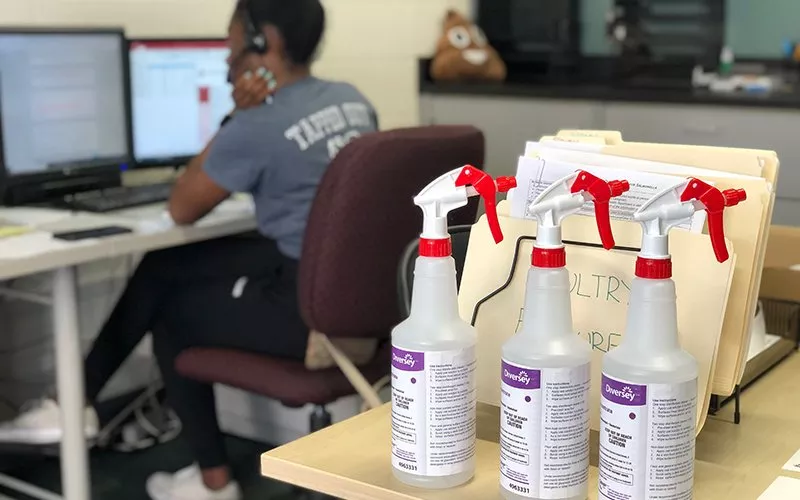
On this fall afternoon, Boyd and Shilen are overseeing 13 volunteers who are calling residents in four Arizona counties to ask questions about COVID-19.
The group is executing two functions that health experts say are essential to preventing the spread of the coronavirus that causes COVID-19 and eventually ending the pandemic: contacting people who have tested positive for the disease and tracking down anyone who may have been exposed.
Boyd and Shilen are coordinators for the SAFER team at the University of Arizona. For 15 years, the Student Aid for Field Epidemiology Response program has trained students to investigate public health crises.
Team members used to track local outbreaks of foodborne illnesses and monitor flu cases. Now they’re tackling a pandemic that has killed 1.5 million people across the globe.
“In the beginning, it was like 10 cases … and then it was 100, and then it was 200. And then you really started to feel the growing pains,” said Erika Austhof, an UA epidemiologist who leads SAFER’s call center.
Case investigations and contact tracing are key to fighting COVID-19. Investigations involve calling individuals who have tested positive to gather information about their illness, travel history and recent close contacts. Contact tracing is when exposed individuals are alerted and given guidance about how to get tested and potential self-isolation.
SAFER does both, and it’s just one of a slew of groups nationwide helping underfunded public health agencies with what has become a colossal effort. Since January, more than 14 million people in the U.S. have been infected.
Kristen Pogreba-Brown, an assistant professor of epidemiology at Arizona who leads SAFER, said volunteers who stepped up in the early days of the pandemic were vital in getting the work off the ground.
“We were just kind of running around with our hair on fire … and just having people say, ‘Tell me what you need help with,’ ‘We can help make phone calls,’ ‘I can help do this’ – that was extremely important in the very beginning,” Pogreba-Brown said.
In April, researchers at the Johns Hopkins Center for Health Security estimated that at least 100,000 new contact tracers would be needed in the U.S. to meet the demand caused by rising COVID-19 cases. But funding that many contact tracers would take billions of dollars.
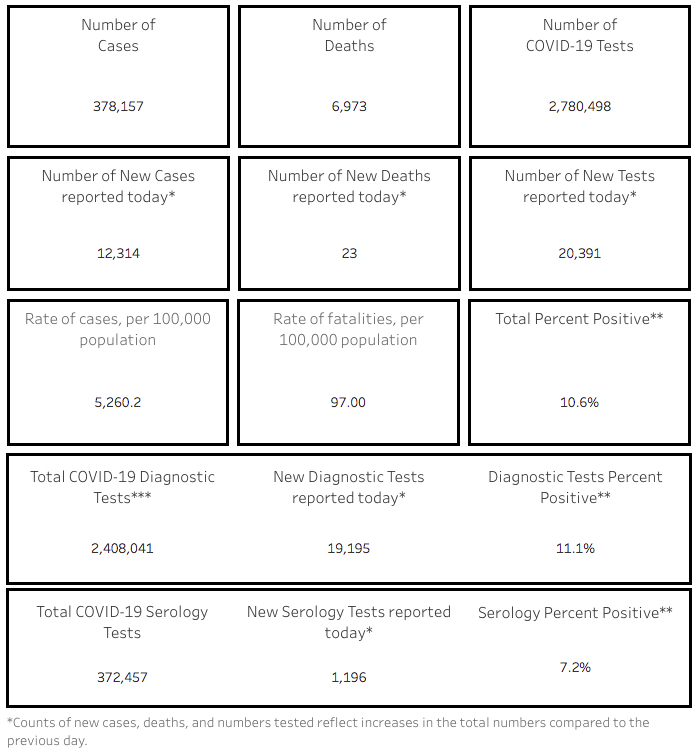
With more than 12,000 new cases reported today, the number of Arizona’s confirmed novel coronavirus cases topped 378,000 as of Tuesday, Dec. 8, according to the Arizona Department of Health Services.

Pima County, which reported 957 new cases today, has seen 46,849 of the state’s 378,157 confirmed cases.
With 23 new deaths reported today, a total of 6,973 Arizonans had died after contracting COVID-19, including 730 deaths in Pima County, according to the Dec. 8 report.
The number of hospitalized COVID cases statewide continues to soar upward as the virus has begun to spread more rapidly, putting stress on Arizona’s hospitals and closing in on numbers not seen since July peaks. ADHS reported that as of Dec. 7, 3,157 COVID patients were hospitalized in the state, the highest that number has been since July 17. That number peaked with 3,517 hospitalized COVID patients on July 13; it hit a subsequent low of 468 on Sept. 27.
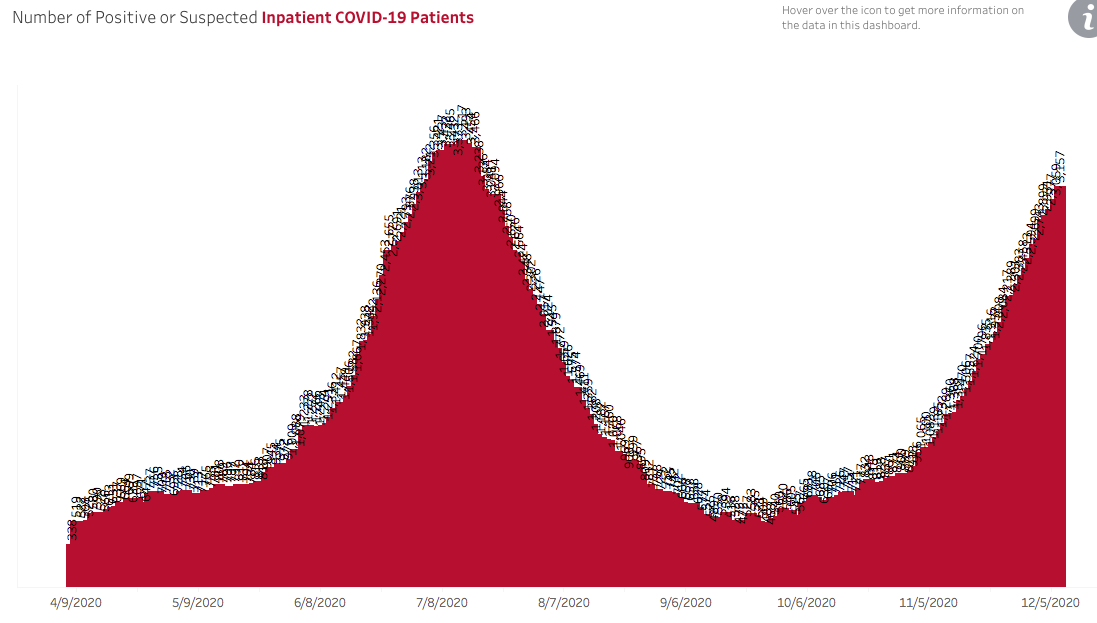
A total of 1,550 people visited emergency rooms on Dec. 7 with COVID symptoms. That number peaked at 2,008 on July 7; it hit a subsequent low of 653 on Sept. 28.
A total of 744 COVID-19 patients were in intensive care unit beds on Dec. 7, the highest that number has been since July 29. The number of COVID patients in ICUs peaked at 970 on July 13 and hit a subsequent low of 114 on Sept. 22.
Judy Rich, president and CEO of Tucson Medical Center, warned the Tucson City Council last week that local hospitals are near or at capacity.
“I believe stricter measures, like the ones we used earlier this year, are the only path to avert the impending crisis,” Rich told the council. “I recognize that the City might not have the legal authority to mandate such actions, but it should be the position of the City to advocate to state leadership that it is required to prevent unnecessary loss of life and illness.”
Pima County has seen a dramatic rise in cases in recent weeks, according to an Dec. 4 report from the Pima County Health Department. (Numbers in this report are subject to revision.) For the week ending Nov. 7, 2,119 cases were reported; for the week ending Nov. 14, 2,578 cases were reported; and for the week ending Nov. 21, 3,313 cases were reported.
WASHINGTON – The Trump administration said Monday it will abide by court order – for now – to start accepting new Deferred Action for Childhood Arrivals applications, a move that could affect an estimated 682,000 undocumented immigrants.
The Department of Homeland Security is already looking to appeal the Friday court ruling, but advocates for immigrants were celebrating the decision that they called critical to the lives of DACA recipients, including thousands in Arizona.
“A lot of young people are going to be able to get deferred action so they won’t be eligible for deportation if they follow the rules, they’re going to get work permits and the ability to work and contribute to their household,” said Jose Patiño, a DACA recipient and education director at Aliento, an immigrant advocacy group in Phoenix.
The decision could affect 1.3 million people in the U.S., according to the Migration Policy Institute, which said about 682,000 have yet to apply for DACA protection. In Arizona, the ruling has the potential to almost double the number of DACA recipients, from the current 24,140 to an estimated 47,000 in the state who could be eligible.
The Obama-era policy defers deportation for immigrants who were brought to this country illegally as children and have known no other home, allowing them to get driver’s licenses, work permits and Social Security numbers. It lets them “feel like they’re part of the country,” Patiño said Monday.
Then-candidate Donald Trump targeted the program, which was enacted as a policy change and not by law, as presidential overreach and promised to do away with it if elected. On Sept. 5, 2017, then-Attorney General Jeff Session did just that, announcing plans to “wind down” DACA over a six-month period, during which the administration invited Congress to enact DACA as law.
Congress did not, but the proposal to end DACA was challenged almost immediately in court. It ultimately landed in the Supreme Court, which ruled that the administration had not followed the proper procedures to rescind the program.
Monday, December 7, 2020
The future of Arizona’s economy is one of uncertainty, UA economist George Hammond made clear at a virtual economic outlook event Friday. Throughout the coronavirus pandemic, the state has fared better in unemployment numbers compared to the rest of the nation, but it has still withstood a heavy loss, according to Hammond, the director of the Economic and Business Research Center at the University of Arizona’s Eller College of Management.
Arizona lost 294,600 jobs from February to April but has replaced 66% of them, according to Hammond. Nationwide, nearly 55% of jobs lost during this time have been replaced. “That's job growth at a pretty rapid pace for the state of Arizona. On average, that translates into almost 14,000 jobs per month,” Hammond said. “If we can sustain that pace, in 2021, we will actually be back to pre-pandemic employment levels by about the middle of the year.” In order to reach pre-pandemic levels, Arizona would have to add 100,700 jobs—an average of 13,900 per month.
“That's a pretty tall order. Adding jobs at a monthly rate of 14,000 is more than double the average monthly job growth rate during the four years before the Great Recession,” Hammond said. “Before the Great Recession . . . we would add, on average, about 6,000 jobs per month. It's not clear that we can sustain that pace.”
The total unemployment rate in Arizona has shown volatility from month to month, with the seasonally adjusted rate decreasing from 10.7% in July to 5.9% in August, then rising to 6.5% in September and 8.0% in October. However, Hammond said this may change when the state receives more precise data in 2021.
“[The unemployment rate] zig-zagged around, with big drops, and then a couple of months of pretty significant increases and then some more drops. The state rate is has looked really weird, and there's a lot of speculation about what might be driving that,” Hammond said. “Probably the best advice is don't put too much weight or spend too much time trying to explain these monthly zigzags...they'll likely be revised away once we get the revised data in March of next year.”

