Monday, October 12, 2020

As the end of the global pandemic continues to lag into the distant future, local businesses are gaming out on how to reach customers effectively yet safely. Startup Tucson, a nonprofit broadly focused on enhancing the Southern Arizona economy through increasing entrepreneur quality, quantity and diversity, has established digital programming to mentor experienced entrepreneurs as well as first-time founders. Startup Tucson’s classes cover online commerce as well as help for entrepreneurs navigating the first steps and risks associated with starting a business.
A new five-part Startup Tucson series starting on Oct. 13, Startup Fundamentals, encompasses these key points. From the start of the program, participants will learn the difference between what it means to an “intentional entrepreneur” and “accidental entrepreneur,” according to Liz Pocock, CEO of Startup Tucson.
“A lot of things are changing in terms of customer behavior," Pocock said. "You’re seeing people interact differently with products online, you’re seeing people interact differently with products in person, so I think now more than ever, it is really important to understand who your customer is and what problem you’re solving for them.”
Pocock explained that entrepreneurs will also learn about the “Lean Business Model Canvas,” which consists of developing a detailed but concise one-page business plan. The business plan is meant to help entrepreneurs understand what risks may arise in launching their business, who their target customers are and what issues they are looking to solve for those customers. Then, modifications can be made to the one-page business plan as the entrepreneur engages in more market research and analysis of competitors.
Additionally, Pocock said that entrepreneurs will learn about customer customer communication skills, figure out the needs of customers and choose the most cost-effective ways to provide the most suitable products.
A customer discovery tool that will be integrated into the lessons is a process Pocock simply calls “experimentation.” This process is meant to help entrepreneurs find the least expensive and least resource-intensive tool possible to reach customers and validate that a product is of interest to them. For example, a business may post a webpage about a product and attach a poll asking what customers think about it, which would be a cheap way to quickly discover how much of a need there is for the product.
“One of the things we try to help founders understand is that sometimes you can validate your market before you spend all of this funding into it,” Pocock said.
Lastly, Startup Fundamentals will cover some entrepreneurial finance basics as well as business basics such as an overview of possible registrations needed, deciding between being a corporation, LLC, or sole proprietorship and dealing with business law and accounting.
At the end, entrepreneurs will compose short presentations to give to the Startup Tucson team and other mentors to help develop a solid pitch of what their business is.
This program is open to any type of business. Pocock explained that even though it will be especially beneficial to first-time founders, it is also meant to assist entrepreneurs who may have had to start their businesses quickly in the past without having all of the foundational knowledge needed. Another type of entrepreneur Pocock referred to, is the type that has been in operation for a while but is now looking to pivot. This could be for example, somebody who has only sold products in-person, and now must shift to fully online.
Pocock believes that this program is especially beneficial during times of COVID-19 because of the rate that the business world is changing. She also explained that despite some of the negative effects of COVID on the economy and the entrepreneurial ecosystem, now actually is a great time to start a business and propel it into the local economy.
“Entrepreneurs are very very important to our local economy,” Pocock said. “I think we’re going to see a return to localism and we’re going to see a return to wanting to shop in our community, so if you’ve ever thought about launching a business for Tucsonans, now is the time to explore that.”
With three seats up for grabs on the Tucson Unified School District’s school board, seven new candidates are vying for a chance to govern Tucson’s largest school district.
A local watchdog group that critically monitors the district, CARE 4 TUSD, hosted an online forum Thursday night for each candidate to outline their views on issues including reopening schools during the coronavirus pandemic, dwindling enrollment numbers and what they would cut from the district’s budget.
Although the current TUSD board has approved a new hybrid learning model, they have yet to vote on a date to return to in-person instruction.
The candidates running for three board positions include Ravi Grivois-Shah, Natalie Luna Rose, Nicolas Pierson, Adam Ragan, Sadie Shaw, Cindy Winston and write-in candidate Cristina Mennella.
Three volunteer, nonpartisan positions on the school board are opening when the terms of current board members Bruce Burke, Kristel Foster and Rachael Sedgwick expire in November.
While the candidates answered questions on a variety of topics at CARE 4 TUSD’s candidate forum, here are the highlights on what they had to say at the virtual gathering.
Meet the candidates
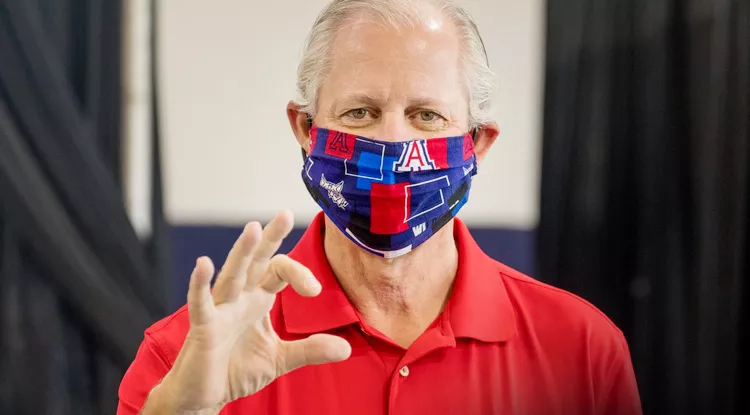
The University of Arizona will allow students to attend in-person classes of 30 students or fewer this week, UA President Robert C. Robbins said in a news conference Monday, Oct. 12.
The change will bring 1,500 more students to campus every week, and classes will continue “if and only if” public health data gauging the spread of coronavirus in the county permits, Robbins said.
The university first predicted 2,500 students would return to class as it moves into Phase 2 of its reopening plan, but fewer students wanted to return than expected.
“Students and their instructors had the opportunity to evaluate what they wanted, and in the spirit of shared governance, make collective decisions about how to proceed at this point,” Robbins said. “There are many, many students who want that in-person interaction . . . but obviously, there are people who don’t want it.”
From Oct. 1-10, UA found 42 positive coronavirus cases after administering 6,963 tests for a positivity rate of 0.6%, down from 2.3% in the previous 10-day period.
“What we’ve been able to show over the last two, four weeks . . . is an ability of how we respond,” Pima County Health Department Director Dr. Theresa Cullen said at the press conference. “We’ve developed this deep collaboration, transparency, sharing of data, sharing resources and a recognition that working together is required for us to combat this pandemic.”
During the past week, the university’s CART team, a collaboration with the UA and Tucson police departments that looks for incidents of noncompliance to COVID-19 precautions, issued five university-related red tags, seven citations and eight code-of-conduct referrals.
Robbins said nine parties CART responded to had more than 10 people, while three parties had about 50.
“It’s important that more and more, we see less and less of these large gatherings, which really are events that you might even term super spreader events when they become too large,” said Richard Carmona, UA Reentry Task Force Director.
Robbins said the university has no recorded cases of COVID-19 transmission within a classroom or laboratory setting.
With six weeks left in UA’s fall semester, the administration is looking ahead to potential coronavirus-spreading events. Halloween falls on a Saturday this year, and many students have traveling plans during fall break.
“We’re working hard to prevent an uptick in positive cases, in part because it could impact positive rates as students are preparing to travel home for the fall break,” Robbins said.
Robbins outlined steps the university is asking students to take to prevent the spread of coronavirus, which include requiring all main campus students to complete a survey with their fall break traveling plans.
UA will also conduct a “testing blitz” from Nov. 9-15, and those who test positive will be required to quarantine for 10 days. Students are also “strongly encouraged” to complete the semester remotely if they travel.
Robbins said a “small number” will be allowed to travel and return to campus in-person, and students will be able to stay on campus during the fall break to access the university’s WiFi.
“We are all happy that all the processes we’ve put in place have resulted in these changes,” Carmona said. “But we still aren’t happy enough to not be very aggressive and continue these processes to keep those numbers down.”

With the election just days away, Cronkite News is profiling candidates who will be on the Nov. 3 ballot. Read Martha McSally's interview here.
How would you rate Arizona’s response to the COVID-19 pandemic, and why?At first, the state responded well to the pandemic, said Kelly, who’s seeking public office for the first time.
“The governor was clearly looking at the data, and I think that’s incredibly important,” he said, adding that shutting down the economy was a hard decision but also the right decision.
However, the state stopped listening to the advice of public health officials and reopened too early, he said, calling the decision political rather than one rooted in facts, science and data. Kelly said politics need to be kept out of such decisions in the future.
“We’ve got a public health crisis that spurred an economic crisis, and I really feel that these things have been made worse by a crisis in leadership,” Kelly said.
If elected, what steps would you take to mitigate the impact of this disease?
With the election just days away, Cronkite News is profiling candidates who will be on the Nov. 3 ballot. Read Mark Kelly's interview here.
McSally touted the Senate measures she has supported, including the Coronavirus Aid, Relief, and Economic Security (CARES) Act. The act’s Paycheck Protection Program, she said, has reinforced Arizona’s economy, saving 1 million jobs and aiding 86,000 businesses.
“We’ve not dealt with something like this in an entire century,” McSally said. “We pray we won’t have to for another century.”
She praised the government’s urgency in reacting to the pandemic.
“My approach in the CARES Act was to get relief out there as quickly as possible to frontline health care heroes,” McSally said, “to get them everything they needed: PPE (personal protective equipment) and investments and treatments and cures and vaccines.”
If elected, what steps would you take to mitigate the impact of this disease?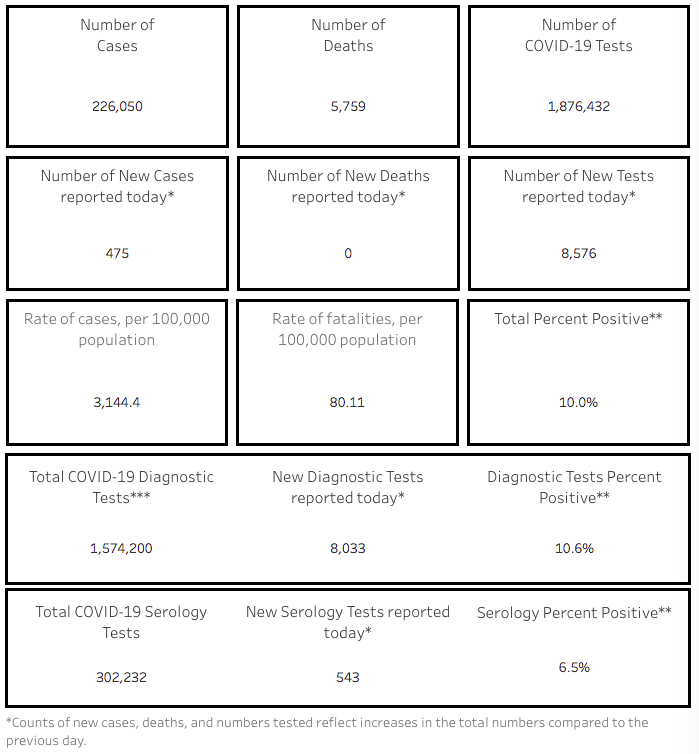
With 475 new cases reported today, the number of Arizona’s confirmed novel coronavirus cases topped 226,000 as of Monday, Oct. 12, according to the Arizona Department of Health Services.

Pima County had seen 26,465 of the state’s 226,050 confirmed cases.
A total of 5,759 Arizonans had died after contracting COVID-19, including 633 deaths in Pima County, according to the Oct. 12 report.
The number of hospitalized COVID cases continues to decline from July peaks. ADHS reported that as of Oct. 11, 667 COVID patients were hospitalized in the state. That number peaked with 3,517 hospitalized COVID patients on July 13.
A total of 710 people visited emergency rooms on Oct. 11 with COVID symptoms. That number peaked at 2,008 on July 7.
A total of 155 COVID-19 patients were in intensive care unit beds on Oct. 11. The number of COVID patients in ICUs peaked at 970 on July 13.
On a week-by-week basis in Pima County, the number of positive COVID tests peaked the week ending July 4 with 2,453 cases, according to an Oct. 7 report from the Pima County Health Department. With the return of UA students, local numbers ticked upward in September but have begun to decline again. For the week ending Sept. 5, a total of 863 cases were reported; for the week ending Sept. 12, 1,105 cases were reported; for the week ending Sept. 19, 1,219 cases were reported; for the week ending Sept. 26, 582 cases were reported; for the week ending Oct. 3, 472 cases were reported. (Recent weeks are subject to revision.)
Deaths in Pima County are down from a peak of 54 in the week ending July 4 to 10 in the week ending Sept. 5, one in the week ending Sept. 12, three in the week ending Sept. 19, two in the week ending Sept. 26 and one in the week ending Oct. 3. (Recent weeks are subject to revision.)
Hospitalization peaked the week ending July 18 with 221 COVID patients admitted to Pima County hospitals. In the week ending Aug. 29, 37 COVID patients were admitted to Pima County hospitals; in the week ending Sept. 5, 26 patients were admitted to Pima County hospitals; in the week ending Sept. 12, 23 patients were admitted; in the week ending Sept. 19, 14 patients were admitted; in the week ending Sept. 26, 11 people were admitted and in the week ending Oct. 3, 17 patients were admitted. (Recent weeks are subject to revision.)
Amphi School District begins in-person classes today
The Amphi School District will start hybrid learning with in-classroom instruction starting today.
Students will attend smaller classes two days a week and learn remotely three days a week.

While Public Brewhouse offered a wide variety of beers from seasonal stouts to Sonoran sours, they also carved out a niche for themselves with trivia nights, board games and live music.
“Our name, Public, comes from the idea that a pub is a public house. We really wanted to create an environment people feel comfortable coming into," head brewer Mike Gura previously told the Tucson Weekly.
Shortly before the pandemic hit, Public Brewhouse expanded in February with a sister location, Public Taphouse at 6720 E. Camino Principal, which remains on COVID hiatus.

WASHINGTON – State and federal officials have agreed on a plan that includes bringing in volunteer sharpshooters to cut the number of bison on the North Rim of the Grand Canyon.
Lethal removal has long been discussed as a way to reduce the herd, along with hazing and relocation, but the Sept. 25 agreement between the Arizona Game and Fish Department and the National Park Service clears a path for it to begin as soon as next year.
Scott Poppenberger, Flagstaff regional supervisor for the Arizona Game and Fish Department, said “the lethal removal component is a big part of this recent agreement,” and believes that the measures to reduce the population will help provide balance to the damaged ecosystem.
It comes amid growing concerns from the public and the park service about the impact the nonnative bison have on natural resources, and worries that they could pose a danger to park visitors.
The animals, descended from early 20th-century attempts to cross-breed cattle and bison, have proliferated in the Grand Canyon National Park, where they currently cannot be hunted. The goal of the agreement is to reduce the current herd of 400 to 600 bison to as few as 200, which would do less damage to the environment.
Tags: bison , grand canyon , Image

WASHINGTON – A Centers for Disease Control and Prevention report Friday credited mask mandates and business restrictions for slowing the spread of COVID-19 in Arizona, reversing an early summer spike blamed on an early easing of restrictions.
The study, in the CDC’s Morbidity and Mortality Weekly Report, tracked cases in the state from Jan. 22 through their peak in June when local and state safety mandates began to take effect.
“We have significantly reduced the cases in Arizona after the implementation of those mitigation measures,” said Dr. Cara Christ, director of the Arizona Department of Health Services and one of the authors of the report.
“So, after masks became required in about 85 to 90% of the population, and then the closure of some of those high-risk activities or establishments, we did see a significant reduction,” Christ said Friday.
Other health experts in Arizona said the report should serve as “a cautionary tale” to other states.